
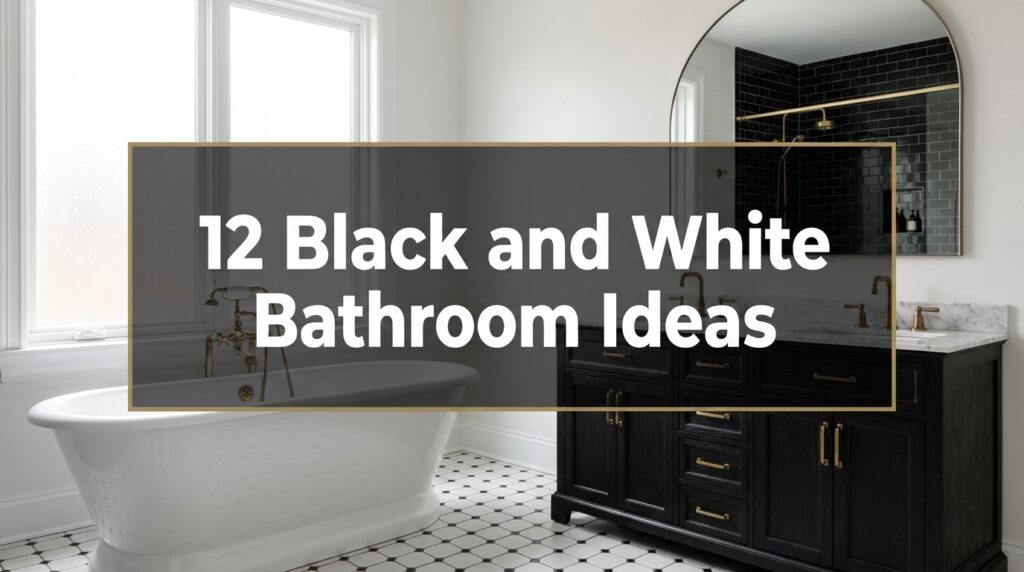
Black and white as a bathroom palette has a genuine advantage most trending color combinations don’t, it rarely looks dated the way a specific paint color or tile trend eventually does. A black and white bathroom from decades ago can still read as classic today, while a room built around a specific popular paint color from the same era usually needs updating within a decade. That staying power comes from real contrast rather than a passing preference, and it’s part of why the combination keeps returning as a genuinely reliable choice.
The risk with black and white isn’t that it looks dated, it’s that a poorly balanced version can feel stark or clinical rather than classic and considered. A bathroom built from equal parts black and white without any warmth introduced somewhere, through brass, wood, or genuine texture, can read as cold despite the palette itself being a genuinely strong foundation. What separates a black and white bathroom that photographs beautifully from one that just reads as sterile comes down to proportion and material choice more than the colors themselves.
These twelve ideas cover that balance, the pattern and tile decisions that make black and white feel intentional, along with the warming details that keep the palette from tipping cold.
1. Choose Classic Checkerboard Floor Tile
A checkerboard floor is one of the most immediately recognizable black and white bathroom signifiers, and it carries genuine historical weight, this pattern has appeared in bathrooms for over a century, which is part of why it reads as timeless rather than trendy. The scale of the checkerboard matters considerably to how the finished floor actually feels, a larger format, generally 4×4 or 6×6 inch tiles, reads as more current than the tighter, smaller-scale checkerboard associated with older, more traditional bathrooms.
Porcelain checkerboard tile in this style runs $4 to $9 per square foot, and choosing a matte rather than glossy finish keeps the floor from feeling overly formal, supporting a slightly more relaxed, current interpretation of the classic pattern.

2. Pair Black and White With Warm Brass Fixtures
Brass fixtures do considerable work toward keeping a black and white bathroom from feeling stark, since the warm metallic tone introduces genuine contrast against the cooler black and white palette without disrupting it. A brass faucet, showerhead, and mirror frame catch available light in a way that pure black or chrome fixtures don’t achieve nearly as effectively against this specific color combination.
This pairing has become one of the more reliable formulas in current bathroom design precisely because it solves the warmth problem so directly. A basic brass faucet runs $100 to $250, and applying the same finish consistently across every visible metal element, rather than mixing brass with chrome, keeps the room reading as considered rather than assembled from unrelated purchases.

3. Use Large Format Subway or Hexagon Tile on the Walls
White subway or hexagon tile on the shower walls or vanity backsplash provides a clean, classic backdrop that lets the black and white palette’s other elements, floor pattern, fixtures, accents, do more of the visual work. Choosing a slightly larger format than the traditional small subway tile, or a hexagon shape rather than a plain rectangle, adds subtle current character without disrupting the classic foundation.
This tile category runs $3 to $8 per square foot depending on shape and finish, and pairing white wall tile with black grout, rather than white or gray, adds a graphic quality that plain white-on-white tile misses, tying the wall treatment back to the room’s overall black and white commitment.

4. Add Black and White Striped or Graphic Textiles
Layered textiles in a black and white striped or graphic pattern, a shower curtain, a bath mat, hand towels, extend the room’s palette into its softer elements without introducing an unrelated third color. This is one of the more affordable ways to reinforce the black and white theme, since textiles need purchasing regardless and choosing them within the established palette costs no more than choosing them in an unrelated color.
A striped bath mat in this style runs $20 to $50, and mixing a few different pattern scales, a bold stripe alongside a smaller graphic print, adds visual interest that a single repeated pattern throughout doesn’t achieve.

5. Choose a Vintage Inspired Freestanding Mirror
A substantial mirror in a black metal or warm brass frame, rather than a plain frameless option, functions as a genuine style statement in a black and white bathroom, reinforcing the classic, considered feeling the palette depends on. An arched or scalloped shape adds character beyond a standard rectangular mirror, and a mirror positioned to reflect a window brings real additional light into the room alongside its decorative role.
This is a meaningful but not enormous investment relative to some ideas on this list, typically $150 to $350 for a substantial framed mirror, and it’s one of the more efficient design choices available since it does double duty as both function and genuine styling.

6. Introduce Warm Wood for Genuine Textural Contrast
A wood vanity, a wood stool, or even a simple wood tray on the counter introduces warmth and organic texture that a purely black and white, hard-surfaced room can otherwise lack. This matters more in this specific palette than in many others, since black and white surfaces, tile, paint, fixtures, tend to be uniformly smooth and cool, and wood is one of the few materials that genuinely breaks that pattern.
Choosing a warm wood tone, walnut or a honey-toned oak, rather than a cooler gray-washed wood, reinforces the same warming effect the brass fixtures provide, creating a consistent material story across the room rather than isolated warm and cool elements sitting side by side.

7. Use a Bold Black Accent Wall Rather Than Scattered Black Details
Committing to a single, genuinely black wall, rather than scattering small black details throughout an otherwise entirely white room, reads as more confident and considered. This works particularly well behind a vanity or as a shower surround, giving the room a clear focal point rather than a palette that feels evenly distributed without any real visual anchor.
A black accent wall costs little beyond paint itself, and testing an actual dark sample across a genuine section of wall matters here, since true black can shift depending on lighting in ways that are worth confirming before committing to a full wall.

8. Choose Black Grout for a Graphic Floor or Wall
Beyond the checkerboard floor tile covered earlier, using black grout consistently on white tile throughout the room, on the floor, in the shower, around the backsplash, reinforces the graphic quality that makes black and white bathrooms feel intentional rather than accidental. This is a detail that’s easy for a contractor to overlook if it isn’t specified clearly, since white or gray grout is often the default unless black is requested directly.
Black grout also shows considerably less visible discoloration and staining over years of regular use than white grout does, a genuine practical advantage that happens to align with the aesthetic goal here.

9. Add Black Framed Windows or Interior Glass Details
Where the bathroom includes a window, or interior glass separating a shower or water closet, a black frame rather than white or unfinished aluminum reinforces the room’s overall graphic quality. This detail extends the black and white contrast into the room’s architectural elements, not just its furnishings and surfaces.
Retrofitting an existing white window frame with black paint or a film application runs considerably less than a full window replacement, typically $50 to $150 for a DIY paint approach, making this a relatively accessible way to extend the palette without a larger renovation.

10. Layer in Black and White Photography or Graphic Art
A single substantial piece of black and white photography or graphic art reinforces the room’s palette while adding genuine visual interest beyond the tile and fixtures. This works particularly well as a focal point above a vanity or in an otherwise plain stretch of wall, and choosing one larger piece tends to read as more considered than several smaller black and white prints scattered across the room.
Quality black and white photography prints in a substantial size run $40 to $120 depending on framing, a relatively affordable way to reinforce the theme without requiring any structural or material change to the room itself.

11. Use Matte Black Hardware Consistently Throughout
Beyond the faucet and showerhead, extending matte black to cabinet pulls, a towel bar, and a toilet paper holder ties every functional element back into the room’s overall palette. This consistency matters as much here as brass consistency matters in the warmer pairing covered earlier, mixing black hardware with chrome or nickel throughout the room undermines the cohesive, intentional feeling the rest of the palette establishes.
A full hardware set in this finish typically runs $60 to $150 for a bathroom’s worth of pulls, bars, and holders, a relatively modest investment relative to how much it contributes to the room reading as genuinely finished rather than partially updated.

12. Balance the Palette Roughly Sixty Percent White to Forty Percent Black
The proportion between black and white matters as much as any individual material choice on this list. A room that’s roughly sixty percent white to forty percent black tends to read as balanced and inviting, while a room pushed toward fifty-fifty or beyond into more black than white can tip from dramatic into genuinely heavy for a room the size of a typical bathroom. This proportion isn’t an exact science, but it’s a useful starting point when deciding how much black to actually commit to across walls, floor, and fixtures combined.
Getting this balance right is often the real difference between a black and white bathroom that photographs as classic and elegant and one that reads as trying too hard. Keeping white as the clear majority tone, with black used deliberately for contrast rather than competing for equal space, tends to produce the more successful result.
A black and white bathroom that photographs beautifully isn’t really about picking the right shade of either color, since both are about as fixed as a color choice gets. It’s about proportion, warmth introduced through brass and wood, and pattern used with genuine intention rather than scattered randomly. Handled that way, the combination holds up as one of the more reliably timeless choices available for any bathroom.