
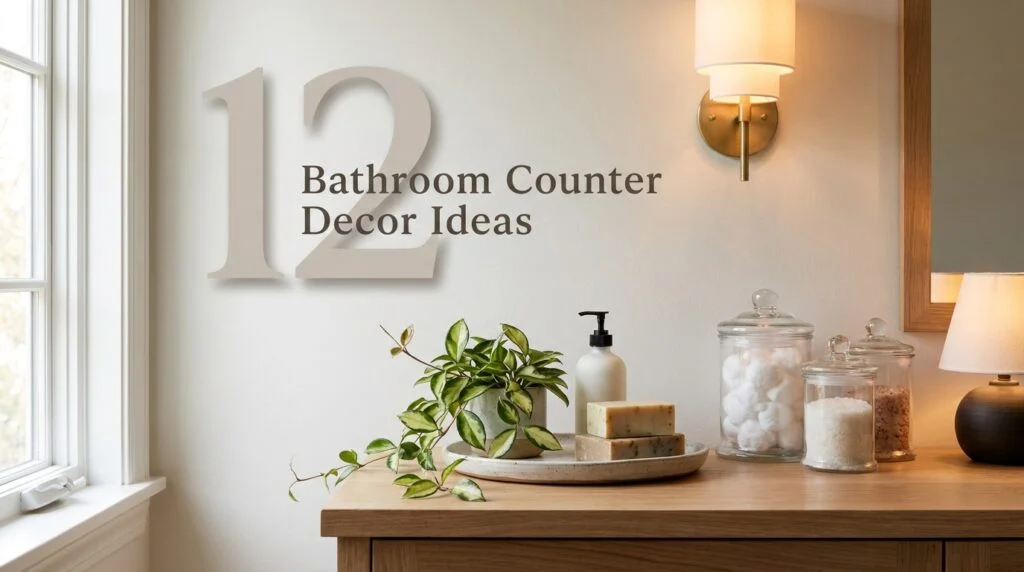
A bathroom counter gets used more than almost any other surface in the house, and that’s exactly why it’s so hard to keep looking styled. A toothbrush, a bottle of moisturizer, a stray hair tie, all of it accumulates within a day of a carefully arranged counter being photographed for a mood board. The gap between a bathroom counter that looks good in a single photo and one that actually holds up to real daily use comes down to a fairly specific set of choices, not just picking pretty objects.
What actually works is less about finding the right decorative items and more about building a system, where daily-use items live, how they’re grouped, what materials hold up to water and humidity without looking worn within a few months. A counter styled around genuine daily function tends to stay looking good far longer than one arranged purely for a single photo.
These twelve ideas cover that full range, from the storage decisions that keep clutter contained to the material and styling choices that make a bathroom counter feel genuinely considered every single day, not just on the day it was first arranged.
1. Use a Tray to Contain Daily Essentials
A tray does more for a bathroom counter’s overall look than almost any single decorative object, since it draws a visual boundary around the items that get used daily, a hand soap pump, a lotion bottle, a small dish for rings. Without that boundary, these items scatter across the counter individually, and even attractive products start to read as clutter once there are five or six of them spread across an open surface.
Ceramic and stone trays tend to hold up better than wood or metal ones in a genuinely humid bathroom environment, since they resist water staining and don’t develop the kind of warping or tarnishing that daily splashes can cause over time. A tray in the 10 to 14 inch range fits most standard vanities without overwhelming the available surface, leaving enough open counter space for actual use beyond what’s contained on the tray itself.
Grouping by function rather than by color or shape tends to produce a more practical result too. Everything used during a morning routine goes on one tray, and anything used less frequently gets moved into a drawer or cabinet, so the visible tray genuinely reflects daily use rather than becoming its own separate clutter zone.

2. Choose Glass Apothecary Jars for Cotton and Bath Salts
Clear glass jars filled with cotton rounds, cotton balls, or bath salts add real texture to a counter while keeping small, loose items from scattering directly across the surface. This works particularly well for anything that would otherwise sit in its original plastic packaging, since swapping a cotton ball bag for a glass jar changes the whole visual tone of the counter without changing the actual product being used.
Apothecary-style jars with a fitted lid keep contents genuinely dry in a humid bathroom, which matters for bath salts especially, since exposed salt can clump or draw moisture from the air within days in a shower-adjacent room. A jar in the 16 to 24 ounce range holds a reasonable supply without needing frequent refilling, and choosing a slightly frosted or ribbed glass texture over perfectly clear glass hides water spots and residue better over weeks of regular handling.

3. Add a Small Trailing Plant That Tolerates Humidity
A small plant brings genuine life to a bathroom counter in a way that decorative objects alone can’t replicate, but bathroom conditions rule out a lot of popular houseplant choices. Pothos and philodendron both genuinely thrive in bathroom humidity rather than just tolerating it, and either does reasonably well even without direct sunlight, provided the room gets at least some natural or bright artificial light during the day.
A small pot in the 3 to 4 inch range fits most vanity counters without taking up space needed for actual daily items, and choosing a simple, matte ceramic pot rather than a glossy or patterned one keeps the plant from becoming a competing focal point against the rest of the counter’s styling. If the bathroom genuinely has no window and relies entirely on artificial light, a well-made faux version is a more realistic long-term choice than replacing a struggling real plant every few months.

4. Choose a Soap Dispenser That Matches the Room’s Hardware Finish
A mismatched soap dispenser, a bright chrome pump against otherwise matte black faucet and cabinet hardware, is one of the more common small details that undercuts an otherwise well-styled bathroom counter. Matching the dispenser’s finish to the room’s established metal tone, whether brass, matte black, or brushed nickel, ties the counter into the room’s broader design rather than treating it as an unrelated afterthought.
Refillable glass or ceramic dispensers tend to look more considered than the dispenser a hand soap bottle originally comes in, and refilling from a larger bulk bottle stored under the sink is often cheaper over time than repeatedly buying individual bottles. A dispenser in the 8 to 10 ounce range needs refilling every week or two with regular use, which is a reasonable maintenance rhythm without becoming a genuine chore.

5. Use a Small Dish for Rings and Jewelry
A dedicated small dish gives rings, earrings, and other jewelry a genuine home during a shower or handwashing routine, rather than leaving them scattered loose across the counter or balanced precariously on the edge of the sink. This is one of the more functional ideas on this list, solving a real daily problem, misplaced jewelry, while also adding a small decorative object to the counter’s overall styling.
Ceramic and stone dishes in the 3 to 5 inch range work well for this purpose, small enough to sit within a styled tray grouping without dominating it, but with enough of a raised edge to actually keep rings from sliding off during normal counter use. Positioning it near the sink specifically, rather than on the far side of the counter, matters for it to actually get used daily rather than becoming just another decorative object nobody interacts with.

6. Add a Single Stem in a Bud Vase
A single flower stem in a small bud vase adds a soft, considered touch to a bathroom counter without requiring the ongoing maintenance a full floral arrangement demands. This works particularly well in a bathroom specifically, since a smaller vase takes up minimal counter space and a single stem is easy to replace every few days without much cost or effort, unlike a larger arrangement that becomes expensive and wasteful to swap out regularly.
A bud vase in the 5 to 7 inch height range fits comfortably on most vanity counters without competing with taller items like a soap dispenser or lotion bottle. Fresh eucalyptus or a single seasonal flower both hold up reasonably well in bathroom humidity for several days, and swapping the water every couple of days prevents the cloudiness that can develop faster in a warm, humid room than it would in a drier space elsewhere in the house.

7. Choose a Wood Tray or Stone Soap Dish for Natural Texture
Natural materials, wood and stone specifically, introduce warmth against the typically cool, hard surfaces of a bathroom vanity, tile, glass, chrome or matte metal fixtures. A wood soap dish or a stone tray softens that hardness in a way that a purely ceramic or glass counter styling doesn’t quite achieve on its own, adding genuine tactile variety to the overall arrangement.
Teak and bamboo both hold up considerably better than softer woods in a genuinely humid bathroom, since their natural oil content resists water damage and warping more effectively over months of regular splashing. A wood soap dish specifically benefits from a few drainage grooves or a raised rim, so bar soap isn’t sitting directly in standing water between uses, which extends both the soap’s lifespan and the dish’s own appearance considerably longer than a flat, non-draining surface would.

8. Style With an Odd Number of Objects Rather Than an Even One
Grouping three objects together on a counter tends to read as more visually balanced and intentional than grouping two or four, a fairly well-established principle in visual styling more broadly that applies directly to how a bathroom counter actually gets perceived. A tray, a small plant, and a single decorative object, three total, tends to look more considered than the same three items with a fourth added simply because it seemed like it might round things out.
This isn’t an absolute rule, a matched pair of items flanking a mirror or a faucet can look intentional specifically because the symmetry itself is the point. But for a more general, eclectic-feeling counter grouping, sticking to three or five objects rather than an even number tends to produce a more polished result without requiring any additional styling expertise beyond just counting what’s actually on display.

9. Use Layered Trays for a Small Counter
Where counter space is genuinely limited, layering a larger tray at the base with a smaller dish or tray stacked on top makes efficient use of vertical space rather than spreading everything across the same flat surface. The larger base tray holds daily essentials, while the smaller top layer corrals rings or smaller items separately, keeping the whole grouping organized without requiring more actual counter footprint than a single tray would.
This works especially well on a compact vanity where every square inch matters, since it lets the same amount of genuinely useful storage exist in a smaller overall footprint. Choosing two trays in a complementary but not identical material, a wood base with a ceramic top layer, for instance, adds visual interest to the layering itself rather than looking like two accidentally mismatched pieces stacked together.

10. Add Soft, Warm Lighting Beyond the Overhead Fixture
A pair of wall sconces flanking the mirror, or even a small plug-in accent light near the counter, changes how the whole styled arrangement actually reads, since standard bathroom overhead lighting tends to be harsh and unflattering in a way that undercuts even a carefully styled counter. Warm-toned bulbs, generally in the 2700K to 3000K range, make the counter’s materials, glass, ceramic, wood, catch light in a considerably more flattering way than a cooler, more clinical bulb temperature would.
This is a genuinely worthwhile investment relative to its cost, since lighting affects how every other idea on this list actually looks in person far more than any single decorative object does. A counter styled beautifully under harsh, cool overhead light will always look less finished than the same exact counter under warm, layered lighting, regardless of how much time and thought went into the styling itself.

11. Choose a Cohesive Color Palette Across Every Object
A counter styled with a tray in warm wood, a bright turquoise soap dispenser, and a stark white ceramic dish reads as scattered even if every individual object is attractive on its own. Committing to two or three colors maximum across the entire counter grouping, generally a neutral base plus one accent tone, produces a considerably more cohesive, intentional-looking result than colors chosen purely on individual preference without regard for how they work together.
This doesn’t require every object to match exactly, subtle variation within the same general tonal family, several different warm neutrals for instance, still reads as cohesive in a way that genuinely clashing bright colors don’t. Before adding a new object to an existing counter arrangement, checking it against the established palette rather than judging it purely on its own merits helps maintain this cohesion as items inevitably get added or swapped over time.

12. Edit the Counter Weekly to Prevent Drift Back Into Clutter
The single biggest reason a beautifully styled bathroom counter stops looking that way within a few weeks isn’t a wrong initial styling decision, it’s the slow, natural accumulation of daily-use items that happens in any bathroom that actually gets used. A stray bottle here, a receipt left on the counter there, and within a month the careful arrangement from move-in or redecorating day has quietly disappeared under real life.
A weekly reset, putting away anything that’s landed on the counter but doesn’t belong in the established styling, takes only a few minutes but prevents the kind of gradual drift that otherwise undoes even the most thoughtfully planned counter arrangement. This is less a one-time decorating decision and more an ongoing habit, and it’s genuinely the difference between a counter that looks styled for a single photo and one that actually looks that way most days of the year.
A bathroom counter that stays genuinely styled over time comes down to building real function into the arrangement from the start, a home for daily items, materials that hold up to humidity, and a habit of resetting regularly, rather than simply choosing attractive objects and hoping they stay that way. Done with that kind of intention, a bathroom counter can look considered on an ordinary Tuesday, not just on the day it was first arranged.