

For a long time, I was completely convinced that dark bedrooms were a decorating mistake. Every guide I read seemed to agree: light walls, bright spaces, maximize the natural light. So I followed that advice faithfully. Crisp white walls. Light grey bedding. A room that was technically bright and technically fine and somehow completely lacking in atmosphere or warmth.
Then I stayed in a hotel room with charcoal walls, deep linen bedding, and warm brass lamps glowing on either side of a low bed. I slept better than I had in months. The room felt like it was wrapping around me rather than simply containing me. I came home and stared at my pale bedroom and realized immediately what it was missing. Not more light. More depth.
Dark bedrooms get misunderstood constantly. People fear they will feel small or oppressive. But when done thoughtfully, a dark bedroom does the opposite. It creates a sense of shelter and intimacy that pale rooms rarely achieve. The right dark tones feel cocooning rather than constricting. Warm rather than cold. Deliberate rather than dramatic.
These 17 ideas are the ones worth knowing before you commit to that first bold paint purchase.
1. Start with Deep Wall Color
The wall color is where every dark bedroom begins and honestly where most people hesitate longest. That hesitation is understandable but usually unnecessary. Deep tones like charcoal, forest green, navy, and warm black do not shrink rooms the way older decorating wisdom suggested. They create depth and envelope the space in a way that feels genuinely different from anything a pale wall achieves.
The key is warmth within the darkness. A cool blue-black can feel harsh and uninviting. A warm black with brown undertones feels luxurious. Charcoal with green undertones feels earthy and alive. Paint a generous test swatch first and live with it for a full day across different light conditions before committing to the whole room.
Key Design Tips
- Test paint colors in both natural daytime light and warm evening lamplight before deciding
- Warm undertones in dark paint read far more cozy than cool or grey-based alternatives
- Painting trim and ceiling in the same dark tone creates a fully enveloped, cohesive effect
- A single dark accent wall behind the headboard is a lower commitment starting point
- Matte or flat finishes on dark walls absorb light beautifully and look more sophisticated

2. Layer Deep, Luxurious Bedding
Dark bedrooms deserve dark bedding. This sounds obvious once stated but plenty of people paint walls charcoal and then place crisp white bedding on top, which creates a contrast that works directly against the cocooning effect the dark walls were designed to create.
Deep linen in slate grey, chocolate brown, forest green, or midnight navy anchors the bed within the room’s palette rather than fighting it. The bed stops looking like a disruption and starts feeling like the natural center of a moody, deliberately considered space.
Layer textures heavily here. Velvet cushions, a chunky knit throw, a matte linen duvet. The textures catch warm lamplight in the evenings and create a richness that makes the bed genuinely difficult to leave on dark winter mornings.
Key Design Tips
- Match bedding tones loosely to wall color rather than exactly, slight variation creates depth
- Layer at least three textures: smooth linen, velvet cushions, and a knit or waffle throw
- Deep jewel tones like forest green, burgundy, and navy pair beautifully with charcoal walls
- Use euro shams one or two shades darker than the duvet for layered visual interest
- Avoid bright white bedding against dark walls as it creates jarring contrast that disrupts the mood

3. Bring in Warm Metallic Accents
Dark rooms can easily tip toward feeling cold if every material choice follows the same deep, matte direction. Warm metallic accents prevent this entirely. Brass, antique gold, and burnished bronze introduce warmth and light reflection that break the heaviness without disrupting the overall moodiness of the space.
A brass bedside lamp. A gold-framed mirror. Bronze drawer pulls on a dark wood dresser. None of these need to be large or expensive to work effectively. What matters is that they catch the light and glow warmly against the dark backdrop behind them.
Designers lean on this contrast consistently in dark room schemes because it adds dimension. The room feels layered and considered rather than simply painted dark.
Key Design Tips
- Brass and antique gold warm up dark rooms far more effectively than chrome or silver finishes
- Group metallic accents in clusters rather than scattering them randomly across the space
- A large brass or gold-framed mirror amplifies warm light reflection significantly in dark rooms
- Burnished bronze hardware on dark wood furniture creates a tonal effect with beautiful warmth
- Avoid mixing too many metal tones, stick to one or two finishes throughout for a cohesive result

4. Hang Floor-to-Ceiling Dark Curtains
Curtains in a dark bedroom rarely receive the attention they genuinely deserve. Standard curtains that stop awkwardly at the window frame or hover just above the floor interrupt the drama that a dark room is trying to create. Floor-to-ceiling curtains do the opposite completely.
Hanging curtains as high as possible, ideally from ceiling height, and allowing them to pool slightly at the floor creates a dramatic softness that changes the vertical scale of the entire room. The ceiling appears higher. The windows feel more generous. The room gains an almost theatrical quality that suits dark interiors beautifully and naturally.
Charcoal velvet, deep linen in forest green, or heavy cotton in warm black all work. The material should feel substantial because weight is part of the effect.
Key Design Tips
- Mount curtain rods as close to the ceiling as possible for maximum height and drama
- Choose curtains at least twice the window width for a full, generous gather when open
- Velvet curtains add the most warmth and visual texture in dark bedroom schemes
- Allow curtains to touch or just graze the floor for the most elegant, considered finish
- Blackout lining behind decorative curtains adds practical sleep benefits without sacrificing style

5. Choose Dark Wood Furniture
Dark wood furniture belongs in a dark bedroom in a way that painted or light-toned pieces simply do not. Walnut, dark oak, ebony-stained timber, and dark mahogany all contribute to the layered depth that defines a well-executed moody bedroom scheme.
The wood grain adds organic texture that solid dark walls lack on their own. Even when the wall color and furniture tone are similar, the contrast between a flat painted surface and a natural timber grain creates subtle visual movement that keeps the room feeling alive rather than flat and lifeless.
Dark wood furniture also reads as timeless. A good walnut bedside table works in a charcoal bedroom as naturally as it works anywhere else.
Key Design Tips
- Walnut and dark oak are the most versatile dark wood tones for bedroom furniture
- Pair dark wood with warm metallics like brass or bronze to prevent the room feeling too heavy
- Choose furniture with clean, simple lines in dark rooms to avoid visual overcrowding
- A dark wood bed frame is the most impactful furniture investment in a dark bedroom
- Avoid mixing too many different wood tones, one dominant wood throughout reads far cleaner

6. Use Candlelight for Atmosphere
Candlelight does something specific in a dark bedroom that no electric light quite replicates. The flame moves. The shadows shift gently across the walls. The room develops a quality of warmth that feels almost alive in the best possible way.
In a room with dark walls, candlelight becomes dramatically more visible and more beautiful than it appears against pale surfaces. The contrast between the deep wall color and the warm amber flame is genuinely striking. A cluster of pillar candles on a dark wooden tray, a single tall candle on the nightstand, a row of small votives along a windowsill.
The effect is immediate and costs almost nothing to achieve properly.
Key Design Tips
- Group candles in clusters of three or five for a more intentional, considered look
- Use vessels in amber glass, smoke, and dark ceramic for an aesthetic that suits dark rooms
- Warm scents like sandalwood, cedar, amber, and vanilla deepen the cozy atmosphere further
- Battery-operated flame candles work safely on shelves or near fabrics where real flames risk safety
- Place a mirrored or metallic tray beneath candle clusters to reflect the warm flame light beautifully

7. Add Velvet Textures
Velvet and dark rooms belong together. The way velvet catches and absorbs light simultaneously creates a depth of surface that flat or smooth materials never achieve. In a dark bedroom where every texture decision matters, velvet introduces a luxury quality that reads expensive regardless of the actual price.
Velvet cushions in deep jewel tones are the easiest starting point. A velvet headboard in charcoal or forest green transforms the entire wall behind the bed. A velvet bench at the foot of the bed adds a layer of softness and ceremony that the room feels more complete for having.
The material also photographs beautifully in low light conditions, which matters if you ever share the space online or simply want it to look its best in the evenings.
Key Design Tips
- Deep jewel tones like emerald, sapphire, burgundy, and plum work beautifully in velvet against dark walls
- A velvet headboard is the single most impactful velvet investment in any dark bedroom scheme
- Mix velvet with linen and knit textures to prevent the room feeling overly formal or stiff
- Brush velvet cushions and upholstery regularly as the pile flattens with use and loses depth
- Avoid velvet in very humid or poorly ventilated rooms where the fabric can hold unwanted moisture

8. Layer Warm Ambient Lighting
Dark walls absorb more light than pale ones. This is not a design flaw but it does mean that lighting strategy becomes considerably more important in a dark bedroom. A single overhead bulb in a dark room looks harsh and uninviting. Multiple warm light sources distributed thoughtfully throughout the room create something completely different.
Bedside lamps with warm amber bulbs. A floor lamp in the corner casting a soft pool of light. Wall sconces mounted at eye level. String lights along a shelf for the softest possible glow. Each source contributes warmth to a different part of the room.
The room never feels dark in a cold sense. It feels warm in a way that pale rooms rarely manage regardless of how many lights they contain.
Key Design Tips
- Use bulbs between 2200K and 2700K for the warmest, most amber-toned light in dark rooms
- Install dimmers on all light sources for flexible atmosphere control throughout the evening
- Avoid cool or daylight bulbs entirely in dark rooms as they strip all warmth from the atmosphere
- A floor lamp in one corner prevents the light feeling concentrated only near the bed
- String lights along a shelf or behind a headboard add the softest, most diffused ambient layer

9. Hang Dark and Moody Wall Art
Art selection matters differently in a dark room. Bright or colorful artwork against dark walls creates jarring contrast that pulls the eye immediately and disrupts the calm, enveloped feeling the room is designed to create. Tonal, moody artwork works with the room rather than competing against it.
Think dark abstract prints in warm earth tones, black and white photography with deep contrast, botanical illustrations in forest green, or landscape paintings with moody skies and muted palettes. The art should feel like it belongs in the room rather than sitting on top of the color scheme as an afterthought.
Oversized single pieces read better in dark rooms than gallery walls, which can feel visually chaotic against an already bold backdrop.
Key Design Tips
- Choose artwork with warm, dark, or muted palettes that complement the wall color naturally
- A single oversized piece reads stronger and calmer in a dark bedroom than a gallery wall
- Dark frames in black, dark walnut, or antique gold suit moody bedroom art most effectively
- Abstract prints in warm terracotta, deep green, and burnt orange layer naturally with dark walls
- Leaning a large framed print against the wall rather than hanging it creates an effortless editorial feel

10. Invest in a Statement Headboard
In a dark bedroom, the headboard is one of the most visible and consequential design decisions available. It sits at the visual center of the room’s most important wall and shapes the entire atmosphere of the sleeping area. An uninspiring headboard in a dark room is a genuinely missed opportunity.
Upholstered headboards in deep velvet, bouclé in a warm dark neutral, or leather in cognac or deep charcoal all work beautifully. Height matters too. A tall headboard draws the eye upward and gives the room a sense of scale that suits the boldness of a dark palette without feeling overwhelming.
This is one investment worth making well from the beginning.
Key Design Tips
- A floor-to-ceiling headboard panel creates the most dramatic and intentional focal point
- Deeply upholstered headboards in velvet or bouclé add warmth and visual softness to dark walls
- Choose a headboard in a tone slightly different from the wall for subtle, layered contrast
- Tall headboards visually raise ceiling height in rooms where extra scale is welcome
- Tufted or paneled detailing adds tactile interest that remains visible and beautiful in low light

11. Paint the Ceiling Dark Too
Most people stop the dark paint at the walls and leave the ceiling white. The result is a room that feels like it is wearing a separate hat. The white ceiling interrupts the enveloped, cocooning quality that makes dark bedrooms so compelling and distinctive.
Extending the dark color onto the ceiling completes the effect entirely. The room feels fully immersive. The ceiling no longer reads as a separate surface but as part of a continuous, thoughtfully considered whole. Some designers paint the ceiling two shades lighter than the walls for a subtle transition. Others match exactly. Both approaches work far better than stopping at the wall line.
This is the detail that separates a room that almost works from one that truly does.
Key Design Tips
- Extend wall paint onto the ceiling for a fully immersive, cocoon-like enveloped atmosphere
- Using the same color throughout removes all visual interruption between wall and ceiling
- A ceiling two shades lighter than the walls creates a subtle, elegant and natural transition
- Dark ceilings make overhead lighting choices more critical since the surface absorbs more light
- Matte finish on a dark ceiling hides imperfections beautifully and looks the most sophisticated

12. Create a Dark Reading Corner
A reading corner in a dark bedroom transforms how the room gets used and experienced daily. A deeply upholstered armchair or an oversized floor cushion tucked into a corner, a floor lamp angled just right, a small side table holding one book and one drink.
In a dark room, that corner becomes genuinely private and almost theatrical. The lamplight creates a warm pool against the deep walls. The chair feels cocooning rather than simply decorative. The rest of the room recedes gently into soft shadow in a way that feels intentional rather than gloomy or underlit.
Dark bedrooms invite stillness. A reading corner gives that stillness somewhere specific and comfortable to actually live within.
Key Design Tips
- Choose a deep, enveloping chair rather than a slim accent chair for maximum genuine comfort
- Position the floor lamp directly beside and slightly behind the chair for the best reading light
- A small round side table keeps the corner functional without consuming unnecessary floor space
- A throw in a contrasting texture draped over the chair arm adds both visual warmth and daily comfort
- Dark velvet or bouclé chairs disappear beautifully and naturally into a dark room’s palette

13. Introduce Natural Elements for Balance
Fully dark rooms can occasionally tip toward feeling heavy if every material is solid, opaque, and manufactured. Natural elements provide the organic breath that prevents a dark bedroom from feeling dense or closed.
A ceramic vase in a matte earth tone. A trailing plant in a dark concrete pot. A woven basket for storage. A linen throw with a natural undyed texture. Small wooden objects on the nightstand. These details introduce warmth and slight imperfection that manufactured materials simply cannot replicate.
Plants especially benefit from dark room backdrops. Their green tones appear vivid and lush against charcoal or deep navy in a way they never quite manage against plain white walls.
Key Design Tips
- Deep green plants like monstera, pothos, and snake plants appear strikingly vivid against dark walls
- Use terracotta, dark ceramic, or concrete pots that align naturally with the room’s tonal palette
- Woven baskets and linen storage add organic texture without introducing competing or distracting colors
- A wooden tray on the nightstand groups small objects with warmth and natural material contrast
- One or two natural elements are sufficient, overcrowding with plants disrupts the room’s intended calm

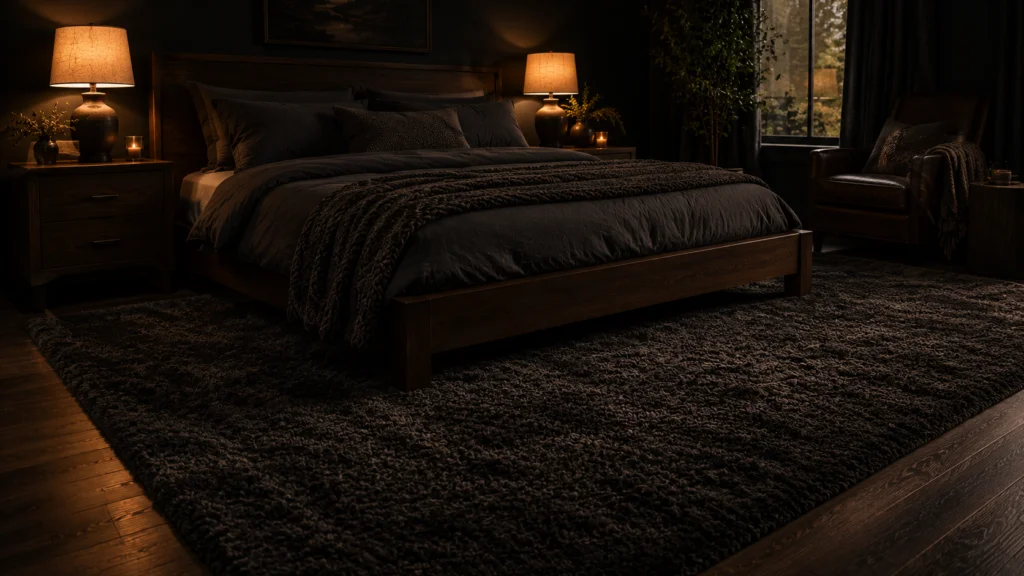
14. Ground the Room with a Dark Rug
A light rug in a dark bedroom creates a visual disconnection between the floor and the room above that feels immediately noticeable and slightly off. The rug looks placed rather than chosen. A dark or deeply toned rug anchors the bed and grounds the entire scheme in a way that reads cohesive and complete.
Deep charcoal, forest green, burgundy, navy, and warm chocolate brown all work depending on the specific wall color. Texture matters here too. A high-pile rug adds warmth underfoot and visual softness to what can otherwise feel like a lot of hard, dark surfaces competing for attention.
The rug does not need to match the walls exactly. It needs to belong within the same tonal family comfortably.
Key Design Tips
- Size the rug generously with at least 18 inches extending beyond each side of the bed
- Dark rugs hide everyday wear and marks far more effectively than light-toned alternatives
- High-pile or shaggy textures add physical softness to a room that can feel visually heavy
- A patterned rug in tonal dark shades adds visual interest without disrupting the atmosphere
- Avoid light or bright rugs in dark bedroom schemes as they interrupt the cohesion significantly
15. Use Mirrors to Add Depth
Dark rooms need mirrors more than pale ones do. Not necessarily to brighten the space in the way people typically think about mirrors but to add depth, movement, and the quality of the room appearing to extend beyond its actual physical walls.
A large leaning mirror against the darkest wall creates spatial complexity. The reflection doubles the room’s visual information without adding any actual square footage. Lamplight catches in the glass and the warm glow bounces back into the space with a softness that feels genuinely beautiful in a dark room at evening time.
Antique or slightly aged mirror glass suits a dark bedroom especially well, adding character rather than the sharp, commercial reflection of modern alternatives.
Key Design Tips
- Lean a large floor mirror against the wall rather than hanging it for an effortless editorial look
- Antique or foxed mirror glass adds warmth and character that modern clear mirrors lack entirely
- Position mirrors to reflect lamplight rather than windows for the warmest possible evening effect
- A gold, brass, or dark wood frame suits dark bedroom aesthetics far better than chrome or white
- Avoid placing mirrors directly opposite the bed where reflections can disturb sleep quality

16. Add Dramatic Bedside Lamps
Bedside lamps in a dark bedroom deserve considerably more thought than they typically receive. The lamp becomes genuinely prominent in a dark room because it provides one of the most concentrated sources of warm light in the entire space. The wrong lamp disrupts the atmosphere immediately. The right one becomes part of the room’s personality and character.
Tall ceramic lamps in matte earth tones, dark glass bases with amber shades, or sculptural table lamps in dark resin all work beautifully. The shade color matters especially. A white shade throws harsh bright light. A cream, amber, or deep-colored shade diffuses the light warmly and contributes to the room’s overall warmth and palette.
Key Design Tips
- Choose lamp bases in ceramic, dark glass, resin, or metal tones that align with the room’s palette
- Cream or amber lampshades diffuse light most warmly and beautifully in dark bedroom environments
- Tall lamps read more dramatically and elegantly than shorter, squatter designs in bold spaces
- Match lampshades loosely in tone even when bases differ for a cohesive, considered bedside look
- A larger lamp on one side paired with a smaller one on the other adds an editorial asymmetric detail

17. Embrace the Darkness Intentionally
The final idea is perhaps the most important and the hardest to explain practically. Dark bedrooms work best when the darkness is embraced rather than apologized for. Every design decision made from a place of confidence rather than caution produces a noticeably better result.
Resist the urge to lighten the room with too many bright accents, stark white objects, or pale artwork that fights against the palette. Trust that a room can be deliberately dark and still feel warm, generous, and genuinely beautiful. The most memorable interiors are the ones that commit completely to a direction rather than hedging between two competing aesthetics.
Dark, done with confidence, feels like luxury. That conviction is the final ingredient nothing else can substitute for.
Key Design Tips
- Commit fully to the dark palette rather than softening it with too many light or bright elements
- Edit the room regularly, removing any objects that disrupt the cohesive moody atmosphere
- Trust the warmth of layered lighting to prevent the darkness from feeling cold or oppressive
- A dark bedroom photographed in the evening with warm lamps looks extraordinarily editorial and beautiful
- Revisit the room seasonally as dark bedrooms often benefit from slightly different styling across the year


