
The first bathroom I ever tried to decorate was roughly the size of a walk-in closet except it had a toilet, a sink, a tub, and a separate shower crammed inside it. Everything worked. Nothing felt good. My shampoo bottles lived on the floor because there was nowhere logical to put them. The mirror was too small. The lighting made everything look vaguely green. Every morning, it felt less like a bathroom and more like a room I was trying to escape.
I spent months convinced that the problem was square footage that a small full bathroom was simply a lost cause unless you had the budget and the structural freedom to knock down walls. But slowly, through a lot of trial and error, I started to realize something: the bathroom didn’t need to be bigger. It needed to be smarter.
A small full bathroom presents a specific challenge. You’re working with four fixed fixtures toilet, sink, tub, and shower in a space that often hovers between 35 and 55 square feet. There’s not much flexibility. But there’s more design opportunity than most people realize. The difference between a bathroom that feels cramped and one that feels considered almost always comes down to choices: light, scale, storage, texture, and restraint.
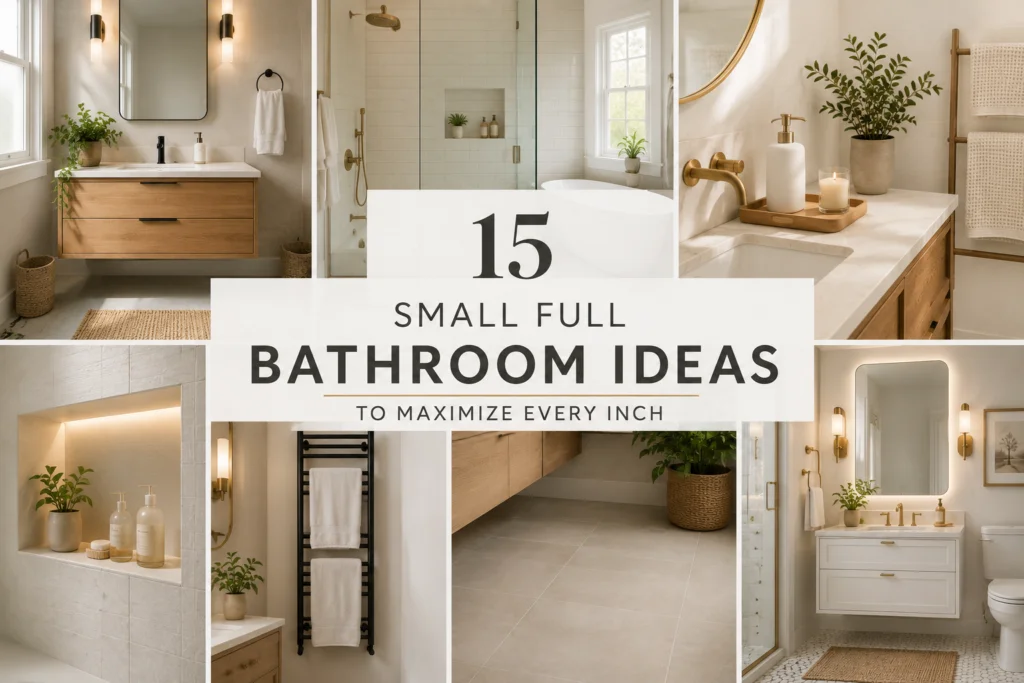
These 15 ideas are the ones that have actually made a difference not in theory, but in practice.
1. Float the Vanity Off the Floor

There’s something quiet and almost immediate about what a floating vanity does to a small bathroom. The moment the floor becomes visible beneath it running continuously from wall to wall without interruption the room exhales. It’s a psychological trick more than a spatial one, and it works every time.
A wall-mounted vanity removes the visual block of cabinet legs and base panels that traditional vanities create. In a bathroom where floor space is already precious, that open stretch beneath the cabinetry makes the room read as significantly larger than it measures. Pair it with handleless drawer fronts in a soft, matte finish warm white, natural oak, or pale sage and the vanity becomes a quiet, architectural detail rather than a focal point competing for attention.
The bonus: that floor space beneath becomes surprisingly useful. A slim woven basket slides neatly underneath. The tile pattern gets to finish its story. The room stops looking assembled and starts looking intentional.
Key Design Tips
- Mount the vanity at 32–36 inches for comfortable everyday use
- Choose deep drawers rather than shelves drawers hold more and stay organized
- Leave at least 9–10 inches of clearance beneath for a properly airy effect
- Pair with matte black or brushed brass hardware for a modern, edited look
- Add a small LED strip beneath the vanity for a soft ambient glow at night
2. Replace the Shower Curtain with a Glass Panel

Shower curtains are one of those decorating habits that feel harmless until you remove one and suddenly understand the problem. In a small full bathroom, a curtain no matter how well-chosen acts as a visual wall. It stops the eye completely, cutting the room in half and making the tub area feel closed off and heavy.
A frameless or semi-frameless glass panel changes that completely. The eye travels through to the tile, the fixture, the back wall. The shower becomes part of the room’s visual story instead of something hidden behind fabric. And if you’ve invested in beautiful tile inside the shower, glass finally lets it do its job.
Fixed glass panels are the most budget-friendly entry point. Full frameless enclosures are the most dramatic. Either way, the room opens up in a way that’s genuinely surprising especially when paired with a clean, cohesive tile choice inside the shower.
Key Design Tips
- Frameless glass creates the most seamless, open effect
- Opt for a towel bar mounted on the glass panel to reduce wall hardware
- Choose a single bold tile accent inside the shower glass makes it visible
- Clean glass weekly to prevent soap film, which dulls the transparency
- A corner glass panel is especially effective in square bathroom layouts
3. Go Large with Floor Tiles

Small tiles with busy grout lines are one of the most common reasons a small bathroom feels more chaotic than it needs to. The eye registers every grid line as a visual interruption. The more interruptions, the busier the floor reads and a busy floor makes a small room feel smaller.
Large-format tiles 24×24 inches, or even 12×24 laid in an offset pattern create the opposite effect. The floor becomes a calm, unbroken plane. The eye moves smoothly across it without stopping to count lines. Light reflects more evenly. The room breathes.
Warm white, soft grey, and pale greige are the tones that work hardest in small bathrooms they reflect rather than absorb light, which keeps the space feeling bright even without abundant natural light. If you’re renovating the floor anyway, this is where the investment earns itself back every single day.
Key Design Tips
- Use rectified tiles for tighter, more consistent grout lines
- Match grout color closely to tile for a near-seamless look
- Avoid patterned or mosaic tiles as the primary floor option in very small rooms
- Extend the same floor tile into the shower base for a continuous flow
- Dark grout divides the floor visually reserve it for accent areas only
4. Build Recessed Niches into the Shower Wall

This is the storage upgrade that feels like it shouldn’t work as well as it does. A recessed niche carved directly into the shower wall between the studs adds meaningful storage without adding a single inch to the room’s footprint. Nothing protrudes. Nothing hangs. Nothing clutters the water stream.
The visual difference is equally significant. A shower with a built-in niche looks designed. A shower with a wire caddy hanging from the showerhead looks improvised and improvised details accumulate quickly in a small bathroom. One deliberate niche, properly waterproofed and tiled, elevates the entire shower area.
If a full renovation isn’t on the table, surface-mounted niche tiles offer a practical middle ground. Either way, getting the products off the floor and onto a proper shelf changes the daily feel of the space more than most decorating changes do.
Key Design Tips
- Build niches horizontally for bottles; vertical orientation suits razors and soap bars
- Use a contrasting tile inside the niche to turn it into a design feature
- Waterproof the niche cavity carefully it’s the most moisture-vulnerable area
- Limit the niche to 3–5 products for a clean, curated look
- Position at shoulder height for the most comfortable everyday access
5. Use Mirrors More Generously

Most small bathrooms have one mirror, positioned directly above the sink, sized just large enough to see a face. It’s functional. It rarely does much more than that. But a mirror has one of the most powerful visual effects of any decorating tool it doubles perceived depth, bounces light across the room, and makes walls feel like they continue rather than end.
Going wider extending the mirror several inches past the vanity on each side changes how the entire wall reads. Going taller, almost to the ceiling, creates the impression of height. A backlit mirror adds both ambient glow and functional task lighting simultaneously. Even a simple change from a small framed mirror to an oversized frameless version shifts the room’s atmosphere noticeably.
The effect isn’t subtle. It’s one of those changes that makes guests pause and look around, trying to identify what’s different without quite being able to name it.
Key Design Tips
- Choose a frameless or thin-profile mirror to keep the look clean and modern
- Extend the mirror 2–4 inches beyond the vanity on each side for a designer detail
- Position mirrors to catch and reflect natural light from a window
- A backlit mirror serves double duty as ambiance and task lighting
- Avoid ornate or heavily framed mirrors in tight spaces they add visual weight
6. Layer Your Lighting

A single overhead fixture is the default in most builder-grade bathrooms. It’s also, almost without exception, the worst lighting option available. Overhead-only light is flat and harsh it creates unflattering shadows and makes the room feel clinical regardless of how beautiful the tile or fixtures are.
Layered lighting changes this completely. The principle is simple: combine ambient light (ceiling or recessed), task light (vanity-adjacent), and accent light (backlit mirror, under-cabinet glow, or a small decorative fixture) to create a room that feels warm and dimensional rather than institutional.
The same small bathroom, relit with wall sconces flanking the mirror and a dimmer on the overhead, suddenly feels like a space designed for comfort rather than just function. That shift from utilitarian to considered is almost entirely achieved through light.
Key Design Tips
- Install wall sconces on both sides of the mirror for shadow-free task lighting
- Use warm-toned bulbs (2700–3000K) for a relaxing, flattering atmosphere
- Add a dimmer switch to overhead lighting for flexible mood control
- Backlit mirrors provide both ambiance and practical illumination
- Consider a small nightlight near the floor for safe, easy nighttime navigation
7. Swap to a Pedestal or Wall-Mounted Sink

Big, boxy vanities consume more visual space than their square footage suggests. In a small full bathroom where floor space is already a negotiation, a vanity that dominates one wall makes the entire room feel crowded even when there’s technically enough clearance to move around.
A pedestal sink or a wall-mounted sink changes the atmosphere immediately. The floor becomes visible. The room opens. There’s an airiness that no amount of organization or styling can replicate while a heavy cabinet sits in the corner.
Yes, you lose storage. That’s the honest trade-off. But it’s a trade-off that can be managed a small floating shelf above the sink, a slender wall cabinet nearby, a woven basket tucked alongside. The visual gain, in a bathroom where you simply cannot add more space, is often worth more than the storage lost.
Key Design Tips
- Pair a pedestal sink with a wall shelf above for towels and daily essentials
- Use a small woven basket beneath for extra storage without visual clutter
- Choose a narrow pedestal depth (16–18 inches) to preserve floor clearance
- Wall-mounted sinks require proper wall blocking plan the reinforcement in advance
- A vessel sink on a slim console table creates a similar open, airy effect
8. Stack Storage Vertically

When floor space has reached its limit, the walls above become the most underused resource in a small bathroom. Vertical storage tall narrow cabinets, floor-to-ceiling shelving, over-toilet towers adds meaningful capacity without consuming an inch of floor area.
There’s also a secondary effect worth noting: tall storage draws the eye upward, which makes ceilings feel higher. When objects are stacked vertically, the room appears to stretch. A well-styled set of floating shelves beside the toilet, reaching toward the ceiling, genuinely makes the bathroom feel more spacious than its measurements suggest.
Style the upper shelves with plants, small decorative objects, or rolled towels in neutral tones. Keep the practical, daily-use items at lower, accessible levels. The combination of function below and beauty above is one of the quietest, most effective tricks in small-space decorating.
Key Design Tips
- Install floating shelves from near-floor to as close to ceiling height as possible
- Reserve lower shelves for practical items; use upper shelves for decorative styling
- Use matching baskets or bins across shelves to control visual clutter
- A tall, slim linen tower beside the toilet is one of the most useful small additions
- Group objects in odd numbers (threes and fives) for a natural, balanced arrangement
9. Install a Pocket Door or Barn Door

Nobody thinks about the door not until someone points out how much space a standard swing door quietly consumes. In a small full bathroom, a door that swings inward or outward creates a clearance arc that makes a meaningful portion of the room essentially unusable. It blocks corners. It limits where furniture can sit. It restricts where people can stand.
A pocket door slides directly into the wall cavity and reclaims every inch of that clearance. A barn-style sliding door does the same on the surface, saving floor space without requiring wall modification. Either option frees up a strip of wall that was previously a dead zone wall space that can now hold a towel hook, a small shelf, or simply breathe.
It’s one of the least dramatic-looking changes available and one of the most spatially impactful.
Key Design Tips
- Pocket doors require clear wall cavity space check for plumbing and wiring first
- Barn doors need at least one full door-width of clearance beside the opening
- A frosted glass barn door preserves privacy while allowing light to pass through
- Invest in quality hardware smooth, quiet operation matters in an enclosed space
- Paint a barn door in a contrasting tone to make it a deliberate design feature
10. Commit to a Limited Color Palette

A small bathroom with too many colors, finishes, and patterns is a bathroom that never settles. The eye moves constantly, searching for a place to rest, and the room feels busy even when it’s technically tidy. It’s one of the most common small-bathroom mistakes filling space with variety in a room that actually benefits most from restraint.
A cohesive palette of two to three tones creates visual calm. It makes the room feel unified rather than assembled. Soft whites with warm wood. Pale sage with brushed brass and cream. Warm greige throughout with matte black fixtures. None of these are boring combinations they’re deliberate ones. And deliberate always reads as spacious.
Limit metal finishes to one, maybe two. Let the tile grout match the tile closely. Introduce color through textiles and plants, where it can be changed easily. The most sophisticated small bathrooms are almost always the most restrained ones.
Key Design Tips
- Use tone-on-tone layering rather than stark color contrast for a serene feel
- Stick to one or two metal finishes throughout the entire room
- Match grout color to tile to minimize visual segmentation
- Introduce personality through textiles, a plant, or a single decorative object
- Dark accent walls work best as a single feature the vanity wall or shower back wall
11. Invest in a Recessed Medicine Cabinet

A surface-mounted medicine cabinet is a box attached to a wall. It protrudes. It creates a shadow line. It adds visual depth where depth is not needed. A recessed medicine cabinet disappears into the wall flush, smooth, architectural and provides all the same storage while taking up no additional room volume whatsoever.
In a small full bathroom, the difference between something sticking out from the wall and something set into it matters. The recessed version feels like it was always meant to be there. It doesn’t interrupt the wall plane. And behind a mirror that would exist in some form regardless, it adds an entire cabinet of organized storage completely invisibly.
If wall construction makes recessing impossible, look for the slimmest surface-mounted option available. The closer to flush, the better.
Key Design Tips
- Choose a recessed cabinet wider than the sink for generous, balanced proportions
- Double-depth interior shelves maximize storage capacity efficiently
- Install at eye height for the primary user typically 60–65 inches centered
- Mirrored cabinet exteriors serve as both vanity mirror and storage simultaneously
- Soft-close hinges prevent slamming and extend the cabinet’s lifespan considerably
12. Introduce Natural Texture

A bathroom that’s entirely hard surfaces tile, glass, chrome, porcelain can feel cold even when it’s genuinely beautiful. Everything reflects. Nothing absorbs. The eye has nothing tactile to rest on. This is a feeling more than a measurable problem, but in a small space where the atmosphere is experienced closely, feeling matters enormously.
Texture is the solution, and it doesn’t require renovation. A waffle-weave linen hand towel. A wooden tray on the vanity holding soap and a candle. A jute bath mat over white tile. A small rattan basket for storage. These additions are quiet they don’t shout for attention but they shift the room’s mood from clinical to considered.
The warmth that natural materials carry into a tile-heavy bathroom is disproportionate to their size. It’s one of the easiest upgrades available and one of the most underestimated.
Key Design Tips
- Layer two or three textures smooth tile, woven linen, raw wood for visual balance
- A wooden bath mat adds warmth and distinctive character over cold floor tile
- Thick, quality towels signal comfort and care even in the smallest spaces
- Rattan and jute are especially effective textures in bright, neutral bathrooms
- Avoid busy patterns let texture do the visual work instead of print
13. Add a Heated Towel Rail

This is one of those additions that lives at the intersection of function and atmosphere and in a small bathroom, that intersection is exactly where the best design decisions happen. A cold towel after a warm shower is a minor irritation. A warm, dry towel is a small luxury that changes the daily experience of the room in a way that no paint color or mirror ever quite can.
Beyond warmth, a slim heated towel rail becomes a design feature. Tall vertical rails in matte black, brushed nickel, or polished chrome are architectural and clean. They replace the need for a traditional towel bar while adding practical warmth and a visual element that looks deliberately chosen rather than incidentally present.
Key Design Tips
- Choose a slim vertical rail to preserve precious wall space
- Electric rails are simpler to install than hydronic versions for most bathrooms
- Position near the shower or tub where towels are most frequently needed
- Use a timer-controlled rail to avoid unnecessary energy consumption
- Matte black towel rails make a strong, confident statement in neutral spaces
14. Prioritize Proper Ventilation
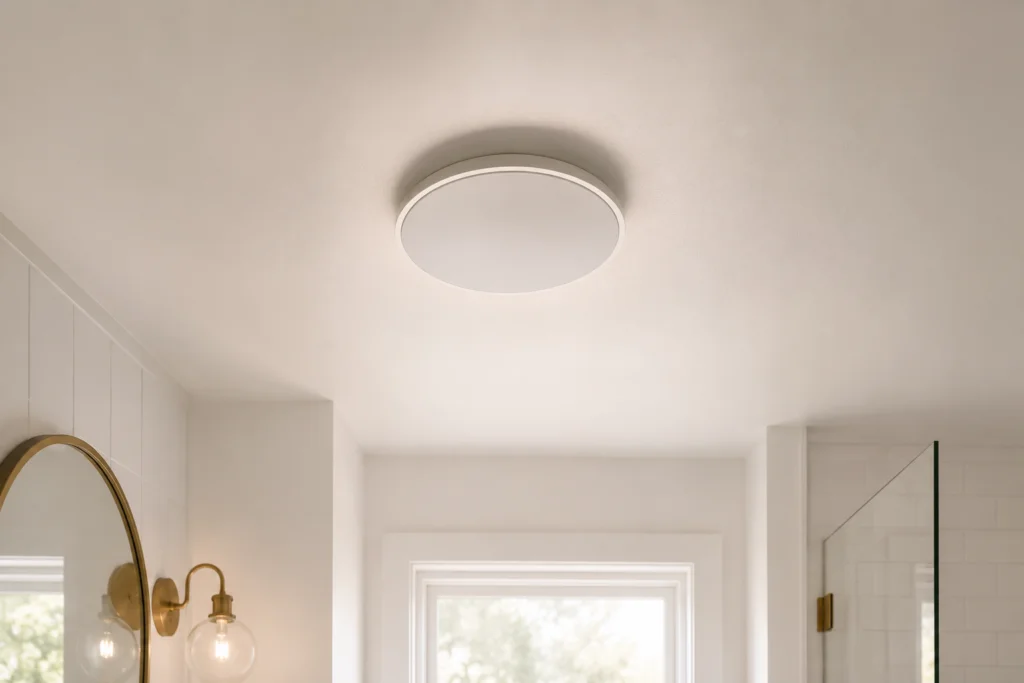
A beautiful bathroom that smells like moisture is still an uncomfortable bathroom. And a small full bathroom where four people may be showering daily in a tight, enclosed space is exceptionally vulnerable to humidity buildup. Mold starts quietly. Grout darkens. Paint peels. The room starts to feel damp in a way that styling simply cannot fix.
The other piece that rarely gets mentioned: a loud, rattling exhaust fan is an auditory irritant in a private space. It’s background noise that makes a bathroom feel cheaper and less comfortable than it needs to. Quiet, efficient exhaust fans rated below 1.0 sone run nearly silently. Add a humidity sensor and the fan activates automatically, the mirror clears faster, and the bathroom stays fresher without anyone having to remember to flip a switch.
Key Design Tips
- Look for fans rated below 1.0 sone for near-silent, comfortable operation
- A humidity-sensing fan removes the need to remember it runs when needed
- Size the fan’s CFM rating to match the bathroom’s square footage for efficiency
- A fan-light combination unit eliminates one ceiling fixture cleanly
- Clean the fan cover every few months to maintain proper airflow
15. Edit Ruthlessly, Then Decorate

This is the one that makes every other idea work. Small bathrooms suffer most from accumulation expired products that never got thrown away, duplicate supplies stored on every surface, decorative objects that stopped feeling right months ago but stayed anyway. Clutter in a small full bathroom doesn’t just look messy. It makes the room feel actively smaller.
The edit comes first. Remove anything that doesn’t belong. Remove anything that’s duplicated. Remove anything you’re keeping out of habit rather than purpose. What remains is almost always less than expected and the room is almost always larger than you remembered.
Then decorate. One small plant. One quality candle. A tray holding only three or four items that are genuinely used and genuinely beautiful. In a small bathroom, restraint doesn’t mean bland. It means intentional. And intentional always reads as more spacious, more considered, and more calm.
Key Design Tips
- Conduct a quarterly bathroom edit to remove expired and unused products
- Limit the countertop to 3–5 objects at most anything more reads as clutter
- Store backup supplies and duplicates in a nearby linen closet or under-sink cabinet
- A single trailing plant pothos, fern, or snake plant adds life without visual noise
- Invest in matching dispensers and containers to unify the countertop visually
Small bathrooms don’t need to feel like compromises. They need to be treated with the same care and intentionality as any other room in the house maybe more. Because when a small space is designed well, the tightness becomes coziness. The limitation becomes a creative constraint. And a room you once rushed through becomes one you actually enjoy spending time in.


