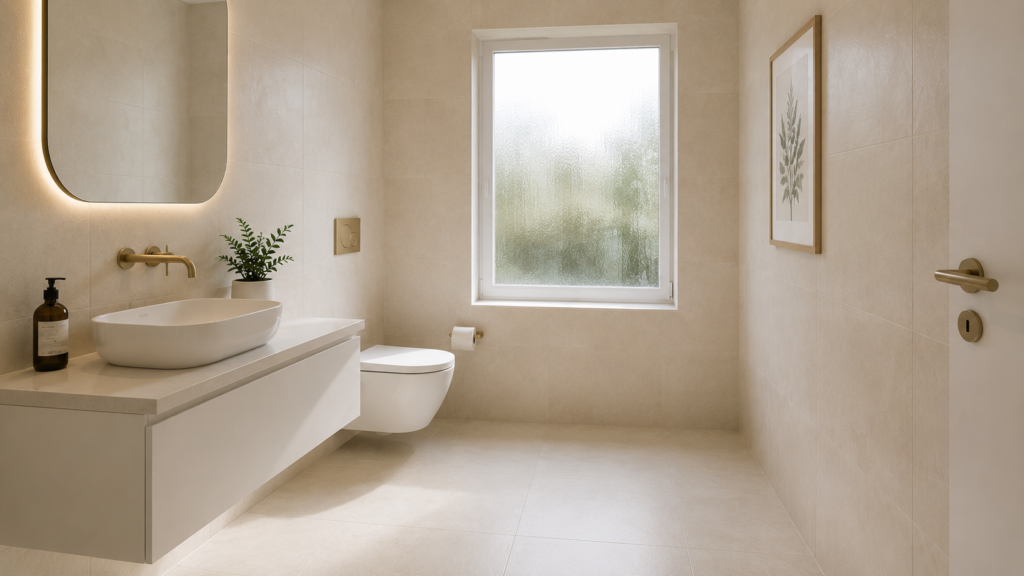
The bathroom that taught me the most about small space design was one I had no choice but to figure out. It was about thirty-eight square feet. One frosted window that faced a brick wall. A toilet, a sink, and a shower cubicle that was technically compliant but barely. The room did not feel small so much as it felt actively hostile to comfort.
I had read plenty of advice about making a small bathroom look bigger. Most of it felt theoretical, written by people who had perhaps seen a small bathroom in a magazine rather than lived inside one every day. The actual solutions that made a genuine difference were quieter and more specific than any list I had found.
What I learned is that the perception of space in a small bathroom comes from a handful of specific visual decisions, not from a sweeping renovation. The way light moves. The way the eye travels across surfaces. Where the floor ends and the wall begins. How visible the floor is. These details, made consistently in the direction of openness, accumulate into a bathroom that feels genuinely larger than its measurements.
These 15 small bathroom ideas are the ones that actually work.
1. Run the Same Tile From Floor to Wall
The most powerful small bathroom idea for creating the illusion of more space is also one of the least discussed. When the same tile runs continuously from the floor up the wall without any visible material change, the eye loses the boundary between the two surfaces. The floor and wall become one visual plane rather than two separate ones. The room appears to expand outward.
This works because visual boundaries create spatial limits. Every time the eye registers a change in material, color, or texture, it reads that change as an edge. An edge is a stopping point. Fewer stopping points mean the room appears to continue rather than end. Using one tile across both surfaces removes the most prominent stopping point in any small bathroom.
Key Design Tips
- Choose a tile that works equally well in both horizontal and vertical orientations
- Use the same grout color across both floor and wall tiles for a seamless, uninterrupted surface
- Large format tiles in a warm light tone work best for this floor-to-wall continuity approach
- Extend the continuous tile into the shower enclosure for the most complete spatial effect

2. Maximize Natural Light With Frosted Glass Windows
Natural light is the most effective tool for making a small bathroom feel bigger and the most frequently underused. In a bathroom where privacy prevents a clear window, a frosted or textured glass window is often treated as a compromise. Done right, it is actually the better option for a small bathroom because it allows maximum diffused daylight while eliminating the visual boundary of a visible window treatment.
A frosted glass window with no blind, no curtain, and no frame obstruction allows light to enter the room completely and bounce across the tile surfaces all day. The room feels open and connected to the outside without sacrificing privacy. This is one of the most effective small bathroom design choices for spaces that feel dim and enclosed.
Key Design Tips
- Remove existing blinds or curtains from frosted bathroom windows to maximize light entry
- Textured frosted glass in a reeded or fluted pattern adds visual interest while diffusing light beautifully
- Position any mirrors to reflect the natural light from the window back across the room
- If adding a new window, position it as high in the wall as possible to maximize light without sacrificing privacy

3. Lay Tiles on the Diagonal
Diagonal tile installation is one of the most effective spatial tricks available in small bathroom design. Tiles laid at forty-five degrees to the wall create a visual dynamic that draws the eye along the diagonal rather than across the shorter straight dimension of the room. The floor appears to lengthen. The room feels more generous in all directions.
It works because the diagonal lines of the grout do not align with the room’s walls and corners. Where square-set tiles echo and reinforce the room’s existing rectangular boundaries, diagonal tiles cut across those boundaries visually and create a floor plane that feels less contained. The effect is most pronounced in very narrow bathrooms where the width dimension is noticeably limiting.
Key Design Tips
- Diagonal tiling works best with square tiles rather than rectangular ones for the clearest diagonal grid
- Use a small border tile in the same tone at the wall edges to finish the diagonal pattern cleanly
- Light colored tiles on the diagonal read more spacious than dark tones in a small bathroom
- A consistent grout tone that is close to the tile color keeps the diagonal subtle rather than dramatic

4. Install a Corner Shower to Reclaim the Center Floor
The position of the shower in a small bathroom has a larger influence on the room’s perceived size than almost any fixture choice. A shower installed in the corner, rather than along the main wall, changes the floor plan of the bathroom fundamentally. The center of the room becomes open floor rather than occupied shower space, and open floor in a small bathroom is the most precious resource available.
A compact corner shower with a frameless curved or angled screen uses the least functional space in the bathroom (the corner) for the most space-consuming fixture. The result is a small bathroom that feels considerably more open at its center, where the body moves and the eye naturally rests, rather than a room where the shower dominates the first thing you see on entry.
Key Design Tips
- A quadrant-shaped frameless shower screen in a corner takes the minimum possible floor space
- Tile the corner shower interior to match the surrounding bathroom walls for visual continuity
- Keep the corner shower compact rather than oversized as a large corner shower loses the spatial benefit
- Frameless or semi-frameless shower screens preserve the openness that a framed cubicle removes

5. Use a Semi-Recessed Basin to Gain Counter Space
A semi-recessed basin, where the front portion of the basin extends outward from the vanity while the back sits within the cabinet, creates usable counter space on each side without requiring the full depth of a standard undermount or vessel sink. In a small bathroom where counter depth is genuinely limited, this difference is meaningful both functionally and visually.
The semi-recessed design also allows for a slimmer vanity cabinet behind the basin, which reduces the overall depth of the vanity unit and creates more floor clearance in front of it. That clearance, even if it is only a few centimeters, contributes to the small bathroom feeling more open and easier to move through during daily use.
Key Design Tips
- A semi-recessed basin typically requires a vanity depth of between thirty-five and forty-five centimeters
- Choose a simple, clean basin form without decorative detailing for the most space-efficient visual result
- Wall-mounted taps above the basin keep the slim counter surface completely clear for daily use
- A semi-recessed basin in white or warm cream suits most small bathroom color palettes naturally

6. Install a Long Horizontal Mirror Across the Full Wall
Most small bathrooms have a single mirror positioned above the vanity, sized to roughly match the width of the basin and the cabinet below it. This is functional but it misses the most significant spatial opportunity a mirror provides. A long horizontal mirror that runs the full width of one wall, from one side to the other, transforms the room’s visual dimensions completely.
The continuous mirror surface doubles the apparent width of the bathroom. The reflected tile, light, and space create the impression of a room that extends through the wall on the other side. This is one of the most powerful small bathroom tricks available because it works regardless of the room’s actual proportions, adding apparent width to narrow bathrooms and apparent depth to square ones.
Key Design Tips
- Mount the horizontal mirror from as close to the ceiling as possible down to the vanity counter level
- A frameless mirror creates the most seamless and space-expanding effect on a small bathroom wall
- Position the mirror opposite or adjacent to the window so it reflects the maximum available natural light
- A backlit horizontal mirror adds both the spatial benefit and warm ambient task lighting simultaneously

7. Keep the Floor Maximally Visible
The amount of visible floor in a small bathroom is one of the most reliable indicators of how spacious the room feels. Every object that sits on the floor, whether it is a freestanding bin, a bath mat left permanently in place, a laundry hamper, or a pedestal sink with a solid base, reduces the visible floor plane and makes the room feel more crowded than it is.
Keeping the floor as clear and visible as possible is one of the most effective small bathroom ideas that costs nothing and requires no renovation. Move everything that does not absolutely need to be on the floor. Install wall hooks rather than floor bins. Choose wall-hung storage over floor-standing units. A bathroom where the floor tile runs cleanly and completely without interruption feels notably more spacious than an identical room with the same floor covered by objects.
Key Design Tips
- Replace floor-standing bins and laundry baskets with wall-mounted or door-hung alternatives
- Remove permanent bath mats and use a quick-drying mat only during and immediately after the shower
- Choose wall-mounted or floating fixtures over floor-standing alternatives wherever possible
- A clear floor also makes the bathroom significantly easier and faster to clean thoroughly

8. Use a Monochromatic Light Color Scheme Throughout
A consistent light, warm color scheme applied across all surfaces of a small bathroom, walls, floor, ceiling, and fixtures, creates a room that appears to expand in all directions simultaneously. When every surface is a variation of the same warm white, soft cream, or pale greige, the eye cannot register individual boundaries between them. The room reads as one generous, unified space rather than a series of separate surfaces defining a small box.
This is the small bathroom design principle that interior designers rely on most consistently. The monochromatic light palette works not because light colors make a room brighter but because they reduce the visual contrast between surfaces that registers as spatial limitation. No dark floor marking where the space ends. No contrasting wall defining the room’s edge. Just a continuous warm envelope.
Key Design Tips
- Choose a warm white or soft cream with yellow or pink undertones rather than cool blue-white
- Apply the same or a very similar tone to the ceiling as the walls for a fully seamless effect
- Introduce subtle variation through texture rather than color within the monochromatic scheme
- Even plumbing fixtures and hardware in a warm or neutral finish contribute to the monochromatic unity

9. Install Flush-Mount or Recessed Ceiling Lighting
Pendant lights and surface-mounted ceiling fixtures that hang below the ceiling plane reduce the effective height of a small bathroom visually by marking the ceiling at a lower point. In a small bathroom where ceiling height is a genuine constraint, any fixture that protrudes downward from the ceiling removes some of the most precious vertical space in the room.
Recessed ceiling downlights sit completely flush with the ceiling surface and leave the full ceiling height visually uninterrupted. The ceiling reads higher. The room reads taller. In a small bathroom where the vertical dimension is one of the few that can be made to feel generous, maintaining that height through flush lighting is one of the most quietly effective small bathroom ideas available.
Key Design Tips
- Use warm white recessed downlights between 2700K and 3000K for a flattering and atmospheric bathroom light
- Position recessed lights to illuminate the vanity area from above and in front rather than directly above
- Supplement recessed downlights with mirror lighting for shadow-free task illumination at the vanity
- A dimmer on recessed bathroom lighting adds significant atmospheric flexibility at low cost
10. Choose Slimline and Compact Fixtures Throughout
Small bathrooms are frequently made to feel even smaller by fixtures that are technically sized for standard rooms. A standard depth toilet that projects forty-five centimeters from the wall. A radiator that extends twenty centimeters into the room on a small wall. A towel rail that interrupts the most useful wall space. Each of these conventional-sized fixtures consumes more of the small bathroom’s limited space than a compact alternative would require.
Compact and slimline fixtures are designed specifically for small bathroom dimensions. A short-projection toilet that sits only twenty-five centimeters from the wall. A slim panel radiator rather than a traditional horizontal rail. A slimline heated towel bar rather than a wide ladder rail. Each swap recovers a small amount of space that accumulates into a bathroom that genuinely feels and functions more openly.
Key Design Tips
- Short-projection toilets are available from most major sanitary ware manufacturers at standard price points
- A slimline heated panel towel warmer takes less wall space than a horizontal rail and heats towels equally well
- Compact corner basins recover significant floor and wall space compared to standard wall-centered alternatives
- Measure every fixture’s projection from the wall before purchasing rather than relying on showroom sizing impressions

11. Apply a Light Gloss Tile to Bathroom Walls
Matte wall tiles absorb light. Gloss tiles reflect it. In a small bathroom where light is one of the most effective tools for creating the perception of more space, a gloss or semi-gloss tile on the walls amplifies every available light source and bounces it across the room in a way that matte surfaces simply cannot.
The reflection from a gloss wall tile is not mirror-like. It is subtle and diffused, more like the reflective quality of a calm water surface than a literal mirror. But that subtle reflectivity meaningfully increases the apparent brightness of the room, which reads as more space. Gloss white or very pale gloss tiles are one of the most effective and straightforward small bathroom ideas for rooms that feel dim and compressed.
Key Design Tips
- Semi-gloss tiles offer the reflective benefit with slightly less visible fingerprint and water mark marking than full gloss
- Large format gloss tiles reflect light more evenly than small gloss tiles with frequent grout lines between them
- Pair gloss wall tiles with a matte floor tile for a practical combination that prevents the floor from being slippery
- Clean gloss tiles regularly with a streak-free cleaner to maintain the reflective quality that makes them effective

12. Use Glass Shelving Instead of Solid Shelves
Solid shelving in a small bathroom adds storage but simultaneously adds visual weight. A wooden shelf, however slim, casts a shadow, creates a horizontal line across the wall, and registers as an object occupying space. A glass shelf does the opposite. It holds the same objects but disappears visually, allowing the eye to travel across it without registering the shelf itself as a presence in the room.
Glass shelving in a small bathroom allows light to pass through rather than being blocked. The wall behind is visible through the shelf. The shelf appears to float without weight. And the objects placed on it, a small plant, a soap dispenser, a couple of rolled towels, seem to sit on air rather than on a piece of furniture that is taking up the room.
Key Design Tips
- Use toughened ten-millimeter glass shelving rated for bathroom use and appropriate weight loads
- Wall-mounted glass shelf brackets in matte black or brushed brass suit most modern small bathroom palettes
- Position glass shelves where natural or artificial light passes through them for the most visually transparent result
- Clean glass shelves with a streak-free glass cleaner regularly to maintain their visual transparency

13. Remove the Shower Tray for a Flush Floor Drain
A conventional shower tray creates a visible raised platform within the shower area, a physical and visual step up from the bathroom floor. In a small bathroom, this threshold interrupts the floor plane and creates a further boundary within an already bounded space. Removing the shower tray in favor of a flush linear drain at floor level eliminates this boundary entirely.
A flush floor drain allows the bathroom tile to run continuously from the shower zone into the wider bathroom floor without any step, edge, or enclosing tray. The floor becomes one uninterrupted plane. The shower zone and the bathroom floor exist on the same visual level. The room reads as one continuous space rather than a small room containing a slightly smaller shower within it.
Key Design Tips
- A linear floor drain running across the shower entry rather than a central drain suits the flush floor aesthetic best
- Proper waterproofing of the shower zone floor is critical and requires specialist installation before tiling
- The floor tile in the shower zone must have a slip-resistance rating appropriate for a regularly wet walking surface
- A slight gradient in the shower zone floor toward the drain is essential for water to flow correctly without pooling

14. Add Concealed Strip Lighting at Ceiling Height
A warm LED strip mounted in a shadow gap or reveal at the junction between the wall and ceiling creates a band of warm light that makes the ceiling appear to lift. The light source is invisible. What is visible is the warm glow it casts upward and along the ceiling plane, which visually separates the ceiling from the wall and creates the impression of more height than actually exists.
This is one of the more unexpected small bathroom ideas and one of the most effective for rooms where the ceiling height is the most limiting dimension. The warm ambient strip at ceiling height also reduces the visual heaviness of the ceiling itself. A ceiling that glows slightly at its edge reads as higher and more open than one that meets the wall in a sharp, unlit corner.
Key Design Tips
- Use warm white LED strip at 2700K in the ceiling reveal for the most atmospheric and spatially effective result
- The shadow gap or reveal detail needs to be built in during bathroom construction or a full retile
- Connect the ceiling strip lighting to a separate dimmer switch from the main downlights for full atmospheric control
- A ceiling strip in a small bathroom also serves as practical ambient lighting when the main lights are dimmed

15. Edit Aggressively and Let the Room Breathe
Every object in a small bathroom that does not need to be there is actively making the room feel smaller. This is not a styling preference. It is a spatial reality. Countertop clutter reduces the visible counter surface. Floor objects reduce the visible floor. Wall items reduce the readable wall. In a small bathroom, the most powerful design decision available is also the most free: remove everything that is not genuinely necessary and genuinely beautiful.
This editing process reveals how much space the room actually contains, which is almost always more than the accumulated objects suggest. A small bathroom that has been ruthlessly edited, where only the essentials remain and everything else has been stored, binned, or moved out of the room entirely, feels measurably larger than the same room filled with the accumulated residue of daily bathroom life.
Key Design Tips
- Start by removing everything from the bathroom and returning only what is genuinely used at least weekly
- Store backup supplies in a nearby linen cupboard or under-sink cabinet rather than on visible surfaces
- Limit the vanity counter to a maximum of three or four objects at any time
- Repeat the editing process every few months as bathroom clutter accumulates quietly and consistently