

I used to think minimalist just meant beige and not much furniture. It took redoing my own living room twice, the first attempt landing somewhere between sparse and unfinished, to understand that a genuinely calm minimalist room is actually a more deliberate design exercise than a maximalist one. There’s nowhere to hide a wrong decision behind a pile of other decisions. Every piece has to earn its spot, and the negative space between pieces has to be considered just as carefully as the pieces themselves.
That first attempt of mine had a gray sofa, a glass coffee table, and almost nothing else, and it read as unfinished rather than calm, more like a room waiting for furniture to arrive than a room someone had actually chosen to leave open. The difference between that and an actual minimalist living room turned out to be less about how much was in the room and more about how consistent and considered what remained actually was.
These sixteen ideas are what I’d tell a friend starting from scratch, the palette choices that hold up over time, the furniture proportions that make a small collection of pieces feel complete rather than sparse, and the specific habits that keep a minimalist room from slowly drifting back into clutter.
Build the Palette Around One Warm Neutral
A minimalist living room built entirely from cool grays and whites tends to feel cold rather than calm, which is the most common reason people abandon the style after one attempt. Choosing a single warm neutral, a soft greige, warm white, or oatmeal tone, as the dominant wall and upholstery color gives the room a foundation that photographs well and feels genuinely comfortable to sit in day to day. Layering in one or two deeper accent tones through a rug or a single piece of furniture keeps the palette from feeling flat.
The test that actually matters here is whether the room feels inviting after the sun goes down and only artificial light is doing the work, since a lot of cooler minimalist palettes look great in daylight photos and noticeably worse under a standard warm bulb in the evening.
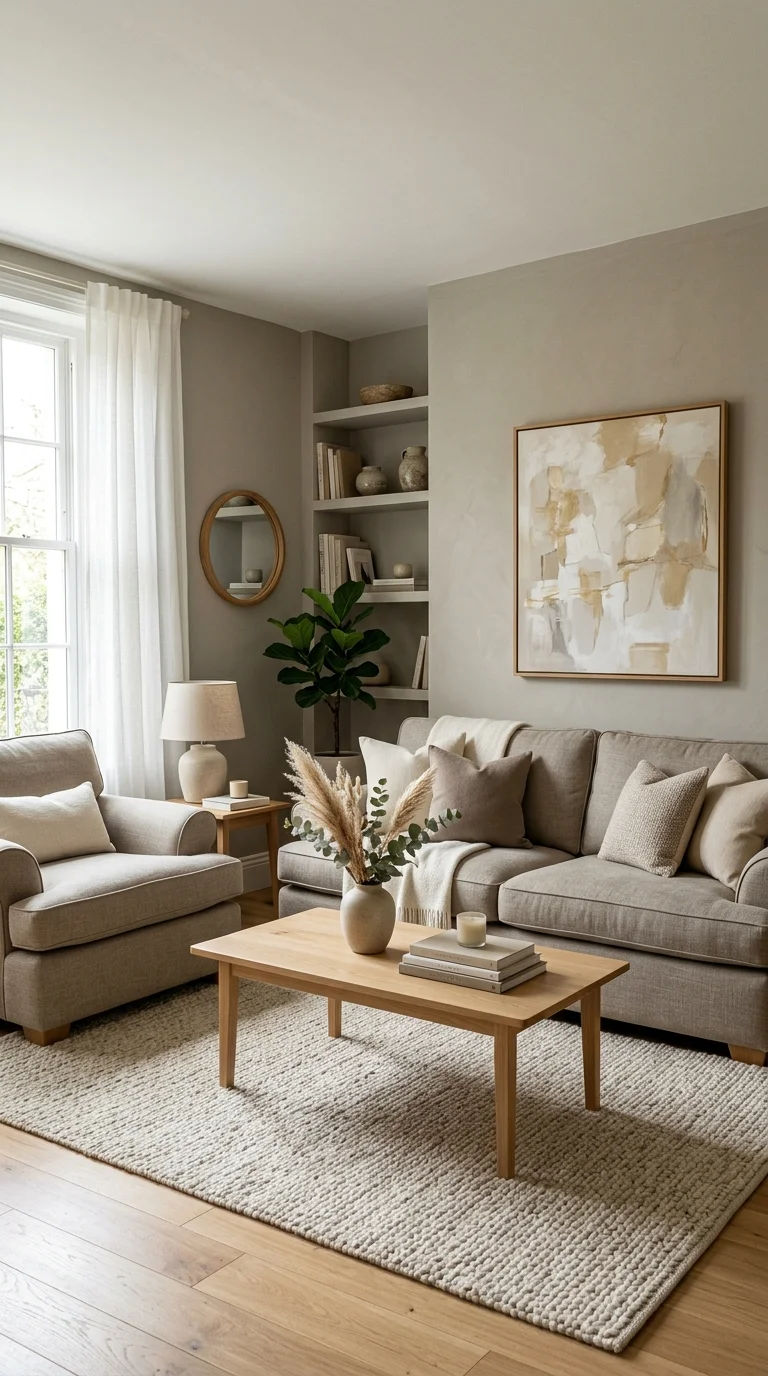
Choose Furniture With Visible Legs, Not Skirted Bases
A sofa or chair with visible wood or metal legs lets light pass underneath it, which makes a room feel more open than the same piece with a floor-length skirt covering the base. This matters more in a minimalist room than almost any other style, since one of the core goals is a sense of visual breathing room, and a skirted sofa effectively adds visual weight to the floor even when the room around it is otherwise quite sparse. Tapered wood legs in a warm tone also tie naturally into the palette guidance above.

Leave at Least Twenty Percent of Wall Space Genuinely Bare
A completely blank wall reads as intentional in a minimalist room in a way that it wouldn’t in a more maximalist one, and it’s one of the easiest details to get wrong by over-correcting toward filling every surface. A reasonable target is leaving roughly a fifth of total wall space without art, shelving, or decor, concentrated as one or two genuinely empty stretches rather than scattered thin gaps between many small objects. This single guideline does more to keep a room feeling calm than almost any individual furniture choice.

Pick One Statement Piece, Not Several Competing Ones
A minimalist living room still benefits from a single piece with real visual presence, a sculptural floor lamp, a bold-shaped accent chair, an oversized piece of art, since a room with absolutely nothing standing out can start to feel more empty than intentional. The key constraint is choosing exactly one. A second statement piece competing for attention undoes the calm the first one was creating, since the eye no longer has a clear place to land.

Use a Low-Pile Rug in a Single Solid Tone
A thick, high-pile rug or one with a busy pattern introduces visual texture that works against the clean lines a minimalist room depends on. A low-pile rug in a solid tone, ideally close to the wall color but a shade or two darker, defines the seating area without adding competing visual noise. Wool or a wool blend in this style typically runs $300 to $800 for a living room sized rug, and the investment tends to be worth it, since a low-quality flat weave shows wear and flattens unevenly within a year or two of regular use.

Keep Coffee Table Styling to Three Objects or Fewer
A coffee table covered in decorative objects, however nice each one is individually, undercuts the sense of restraint the rest of the room is working to establish. A stack of two or three books, a single ceramic bowl, one candle, is usually the realistic ceiling for what stays out permanently. This isn’t about a single dramatic decluttering moment, it’s a habit that has to be maintained, since coffee tables are a natural landing spot for daily items that accumulate without anyone deciding to put them there.

Choose Window Treatments That Disappear When Open
Heavy drapery, even in a neutral color, adds visual bulk to a wall in a way that works against a minimalist room’s clean lines. Simple roller shades, or slim linen curtains that stack neatly to one side when open, keep the window itself as the visual feature rather than the treatment covering it. This matters especially in a smaller living room, where every additional visual element has proportionally more impact on how open or closed in the space feels.

Group Functional Items Into One Concealed Storage Piece
Remote controls, chargers, coasters, and other daily-use clutter need somewhere to actually live, and pretending they don’t exist is how a minimalist room slowly stops looking minimalist within a few weeks of real use. A single closed storage piece, a media console with doors rather than open shelving, or a large ottoman with a lift-top, gives these items a real home without requiring anyone to be more disciplined than normal. This is one of the most practical, least glamorous decisions on this whole list, and also one of the most important for keeping the look genuinely sustainable.

Favor Natural Materials Over Anything Glossy or Synthetic
Wood, stone, linen, and wool all read as calmer and more considered than high-gloss laminate, plastic, or synthetic velvet, even when the colors are nearly identical. A minimalist room built from natural materials tends to feel warm despite having relatively few individual pieces, since texture is doing real visual work that color alone can’t. This doesn’t mean everything needs to be expensive or artisanal, a simple solid wood coffee table from a mainstream retailer does the job just as well as a costly handmade one.

Keep the Lighting Layered, Not Just One Overhead Fixture
A single central overhead light tends to flatten a room and cast the kind of harsh, even light that makes furniture and architectural details look less considered than they actually are. Two or three lower, warmer light sources, a floor lamp, a table lamp, perhaps a picture light over the single statement art piece, create depth and shadow that makes the room feel more dimensional in the evening. This is genuinely one of the highest-impact, lowest-cost changes available, since it often just means adding a lamp or two rather than any structural change.

Choose Art in Odd Numbers or a Single Large Piece
A gallery wall of many small frames introduces the kind of visual complexity a minimalist room is specifically trying to avoid. A single large-scale piece, or a tightly grouped set of three in matching frames, reads as far more intentional. The large-piece route tends to be the safer choice for a genuinely minimalist result, since even a well-executed gallery cluster still introduces more visual variety than the style typically calls for.

Match Metal Finishes Across the Entire Room
A room with matte black lighting, brass door handles, and chrome furniture legs reads as unplanned even when each individual piece is well chosen. Picking one metal finish and using it consistently across lighting fixtures, hardware, and any visible furniture frames is one of the simplest ways to make a minimalist room feel genuinely cohesive rather than assembled from unrelated purchases over time.

Keep Plant Life to One or Two Specimens, Chosen Deliberately
A single well-placed plant, a fiddle leaf fig or an olive tree in a simple ceramic pot, adds real life to a minimalist room without introducing the visual busyness a larger plant collection would. The pot matters here nearly as much as the plant, a simple, matte, neutral-toned vessel supports the room’s restraint, while a patterned or brightly glazed pot works against it regardless of how well-chosen the plant itself is.

Choose a Sofa Silhouette With Clean, Straight Lines
Overly plush, deeply tufted, or heavily rolled-arm sofas introduce a softness that reads as more traditional or transitional than minimalist. A straight-lined sofa with simple, low-profile arms and a single solid upholstery color keeps the room’s dominant furniture piece consistent with the restraint established elsewhere. This doesn’t mean the sofa needs to be uncomfortable or overly firm, plenty of clean-lined designs use genuinely plush cushion fill while keeping the overall silhouette simple.

Resist Adding a Third Accent Color
The most common way a minimalist living room stops looking minimalist is a slow accumulation of small decorative choices, a colorful throw pillow here, a patterned vase there, until the originally restrained palette has quietly grown to include four or five colors nobody consciously decided to add all at once. Committing to one accent color beyond the base neutral palette, and deliberately declining a second, is what keeps the room feeling edited months and years after the initial decorating decisions were made.
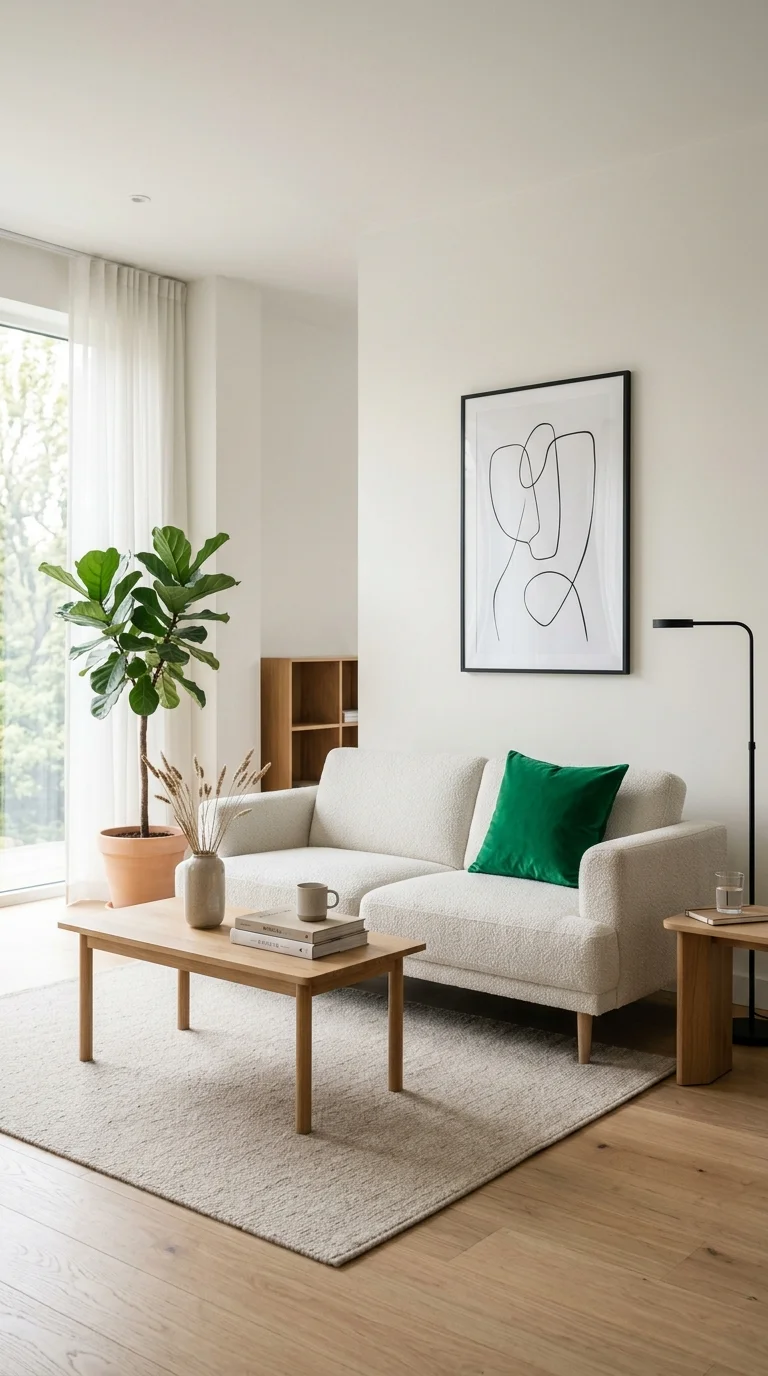
Let the Room Breathe Before Adding More
The instinct to keep adding to a room until it feels finished is strong, and it’s usually the wrong instinct in a minimalist space. A room that feels slightly underfurnished after the main pieces are in place is often actually complete, and the discomfort of that feeling is worth sitting with for a few weeks before assuming more needs to be added. Most minimalist rooms that eventually feel cluttered got that way through exactly this pattern, a slow, well-intentioned drift toward filling a stillness that was actually working.
A minimalist living room that succeeds doesn’t feel bare once you understand what’s actually there. It feels edited, like every choice was made on purpose and nothing is asking for more attention than it deserves. That’s a genuinely different thing from simply owning less furniture, and it’s worth the extra thought it takes to get right.


