

I spent a long time assuming elegant meant expensive, and furnished my first real living room accordingly, a designer-brand sofa I genuinely couldn’t afford, a marble-look coffee table that turned out to be laminate once I saw it in person, a chandelier that dominated the room in a way that felt more like a statement of cost than a considered choice. None of it looked elegant. It looked like someone trying hard, which is close to the opposite effect elegance is actually going for.
What changed things wasn’t a bigger budget the second time around. It was understanding that elegance in a living room comes down to a fairly small number of real decisions, done with genuine care, rather than a large number of expensive-looking purchases assembled quickly. Proportion matters more than price. Material quality matters more than brand recognition. And restraint, choosing fewer things and choosing them well, does more actual work than most people assume when they’re standing in a furniture showroom trying to make a room feel luxurious in one weekend.
These fourteen ideas are the ones that actually held up once I stopped chasing the look of expense and started paying attention to what genuinely elegant rooms have in common. Some of them cost real money. Several of them cost almost nothing and just require a different way of thinking about a choice you were going to make anyway.
1. Choose a Neutral Palette With Real Depth, Not Just Flatness
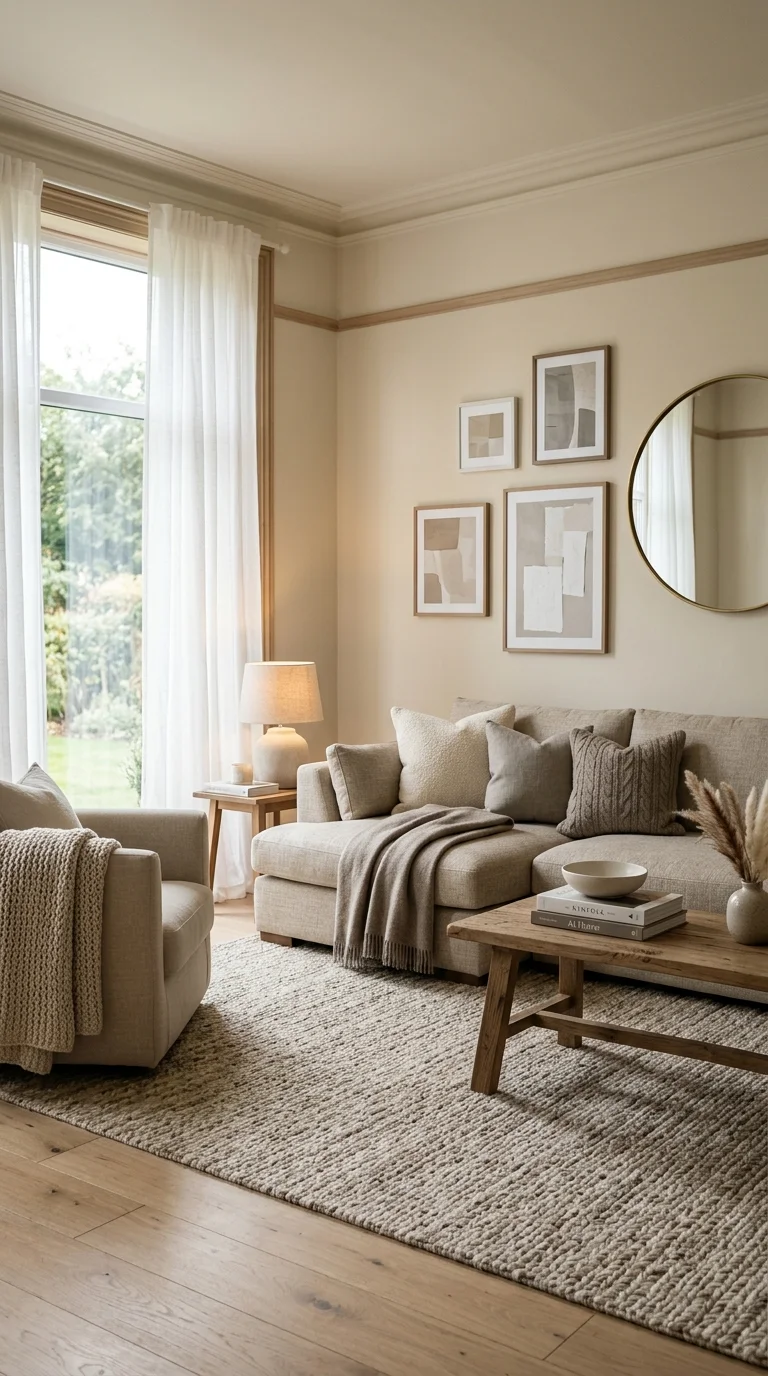
A neutral palette is the foundation most elegant living rooms share, but a genuinely elegant neutral scheme has more tonal variation than people usually plan for. Soft beige, warm ivory, greige, and taupe work well together specifically because they’re not identical, layering slightly warmer and slightly cooler neutrals creates depth that a single flat neutral color across every surface doesn’t achieve.
The mistake worth avoiding here is choosing one neutral paint color and then matching every other element to it as closely as possible. A wall in warm white, paired with furniture in a slightly deeper oatmeal and a rug in a warmer taupe, reads as considerably more sophisticated than a room where the wall, sofa, and rug are all attempting to be the exact same shade. Real elegance in a neutral room comes from this kind of subtle tonal layering, not from perfect color matching.
Testing this in person matters more than people expect, since neutral paint and fabric swatches often look nearly identical under a store’s fluorescent lighting but read very differently once brought home into natural or warm evening light. It’s worth gathering actual samples of everything, paint, fabric, rug material, and looking at them together in the room they’ll actually live in before finalizing anything.
2. Invest Real Money in One Statement Sofa
A living room built around several moderately priced furniture pieces rarely reads as elegant, since the eye tends to notice the accumulation of decent-but-unremarkable choices rather than any single considered one. A single, genuinely well-made sofa, with a quality frame, a durable performance fabric, and a silhouette that will still look current in a decade, tends to do more for a room’s overall feeling of luxury than four or five separate mid-range purchases.
Quality construction is worth understanding specifically before spending real money here. A hardwood frame, rather than particleboard or a softer wood prone to warping, and either high-resilience foam or a down-blend cushion fill, are the details that determine whether a sofa still looks and feels good in five years rather than sagging and looking tired within eighteen months. These details rarely show up in a showroom photo but matter enormously to how the piece actually holds up.
A genuinely well-made sofa in this category typically starts around $2,000 and can run considerably higher depending on fabric and customization, a real investment, but one that pays off specifically because it’s the single largest visual element in the room and the piece most people will actually sit on and judge the room by, consciously or not.

3. Add a Genuine Natural Stone Element, Not a Printed Imitation
Marble, travertine, and other natural stones carry a specific kind of visual weight that printed laminate or porcelain imitations, however convincing from a few feet away, don’t quite replicate up close. A real marble or travertine coffee table, side table, or even a smaller decorative object introduces both genuine texture and the subtle irregularity of natural veining that a manufactured pattern can’t fully copy.
This doesn’t require the largest or most expensive stone piece in the room. A smaller genuine stone side table or a stone-topped tray on an otherwise wood coffee table introduces the material’s real texture and coolness to the touch without requiring the full cost of furnishing an entire surface in stone. The goal is one authentic material moment, not stone everywhere.
Real natural stone furniture typically costs meaningfully more than a printed imitation, often two to four times as much for a comparable piece, and it’s worth handling this decision deliberately rather than defaulting to the cheaper look-alike option purely out of convenience, since the difference is genuinely perceptible in person even to someone without a trained eye for materials.

4. Layer at Least Three Distinct Light Sources
A single overhead fixture, however attractive on its own, creates flat, even lighting that works against the sense of depth and warmth genuinely elegant rooms tend to have. Combining a central fixture with at least two additional sources, a floor lamp, a pair of table lamps, wall sconces, or picture lighting over art, creates the layered shadow and warmth that makes a room feel considered rather than simply illuminated.
Bulb temperature matters as much as the fixtures themselves here. Warm white bulbs, generally in the 2700K to 3000K range, create the kind of soft, flattering light associated with genuinely elegant interiors, while cooler bulbs above 4000K tend to read as more clinical or commercial, regardless of how beautiful the light fixture itself is. This is a detail that’s easy to get wrong even after investing real money in beautiful lighting fixtures.
Dimmer switches are worth the modest additional cost and installation effort, since the ability to adjust brightness throughout the day and evening extends a room’s sense of considered design into how it actually functions, not just how it looks in a single well-lit photograph.

5. Choose Floor-to-Ceiling Curtains in a Substantial Fabric
Curtains that stop short of the floor, or that hang from a rod mounted directly at the window frame’s top edge, work against the sense of height and proportion that elegant rooms typically achieve. Mounting curtain rods close to the ceiling, well above the actual window frame, and choosing curtains long enough to just clear the floor, creates the illusion of a taller window and a higher ceiling, a genuinely dramatic effect for a relatively low-cost change.
Fabric choice matters considerably here too. Linen and velvet both carry real visual weight and drape in a way that lighter, sheerer fabrics don’t, contributing to a room’s sense of substance. Velvet in particular adds a tactile richness that photographs and reads in person as genuinely luxurious, though it’s worth choosing a performance or blended velvet if the room sees significant sun exposure, since natural velvet can fade unevenly over time.
This is one of the more affordable ideas on this list relative to its visual impact, since the main cost is simply choosing longer curtains and a slightly wider rod than the window’s exact dimensions require, a detail that costs little beyond what standard-length curtains would have cost regardless.

6. Introduce Natural Materials Beyond Just Stone
Elegant interiors tend to rely on genuine natural materials, stone, but also solid wood, quality leather, and natural fiber textiles, rather than materials manufactured to imitate them. Even small doses of these materials, a solid wood picture frame, a leather-bound accessory, a wool or silk throw, contribute a sense of quality that’s difficult to fully replicate with synthetic alternatives, regardless of how visually convincing the synthetic version might be from a distance.
This principle extends to furniture hardware and small details as well. Solid brass or bronze drawer pulls, rather than a plated finish over a base metal, tend to age with a genuine patina rather than wearing through to reveal a different color underneath, a detail that becomes noticeable within a year or two of regular use on plated hardware but never becomes an issue on solid metal.
The cost difference for solid materials versus their manufactured equivalents varies considerably by category, sometimes minimal for small accessories, sometimes substantial for larger furniture pieces, which makes this a good area to prioritize selectively rather than assuming every material choice throughout the room needs to be the most authentic, most expensive option available.

7. Choose One Large Area Rug Rather Than Several Small Ones
A living room furnished with multiple smaller rugs, or a single rug too small for its seating area, tends to read as visually fragmented rather than cohesive, working against the sense of considered wholeness that elegant rooms typically have. One substantial rug, sized so that at minimum the front legs of every seating piece rest on it, anchors the entire seating area as a single, deliberate zone.
Material quality matters as much as size here. A genuine wool or wool-silk blend rug holds its shape, resists crushing, and develops a subtle sheen over years of use that synthetic fiber rugs generally don’t achieve, regardless of how similar they might look when first purchased. This is a case where the material difference becomes more apparent over time rather than immediately, which makes it easy to underestimate when comparing options side by side in a showroom.
A properly sized wool rug for a genuinely elegant living room typically runs $800 to $2,500 depending on size and specific weave, a significant single purchase, but one that anchors the entire room’s sense of quality in a way that’s difficult to achieve through smaller, less expensive substitutes.

8. Add Genuine Metallic Accents in a Single Consistent Finish
Small metallic details, lighting fixtures, mirror frames, drawer hardware, decorative objects, introduce a subtle sense of polish that a purely matte, unreflective room often lacks. Brass and warm bronze finishes tend to read as more genuinely luxurious than chrome or overly bright polished finishes, which can veer toward feeling more commercial or dated depending on the room’s overall style.
Consistency matters considerably more here than most people initially assume. A room with brass lighting, chrome cabinet hardware, and a nickel mirror frame reads as unplanned even when every individual piece is well-chosen, since the eye registers the inconsistency even without consciously identifying its source. Committing to one metal finish across the entire room, and applying it consistently to every visible metallic element, is one of the more overlooked details that separates a genuinely cohesive elegant room from one that simply contains elegant individual pieces.

9. Choose Oversized, Considered Artwork Over Multiple Smaller Pieces
A single large-scale piece of art tends to read as more deliberate and more elegant than a cluster of several smaller pieces, even when the smaller pieces are individually quite beautiful. This mirrors a broader principle running through several ideas on this list, fewer, larger, more carefully chosen elements generally create a more sophisticated impression than a larger number of smaller ones competing for the same visual attention.
The art itself doesn’t need to be dramatically expensive to achieve this effect. A well-chosen large-format print in a quality frame, properly scaled to the wall and the furniture beneath it, can achieve much of the same visual impact as an original piece costing many times more, provided the scale and framing are handled with real care rather than treated as an afterthought once everything else in the room is finished.

10. Build Genuinely Custom-Feeling Storage With Built-In Shelving
Built-in shelving, whether genuinely custom millwork or a well-executed approximation using stock cabinetry dressed up with proper trim and consistent styling, creates a sense that the room was designed around the space itself rather than furnished with pieces that happened to fit. This reads as considerably more elegant than freestanding bookcases or media units, which regardless of quality tend to look like furniture placed in a room rather than architecture belonging to it.
Genuine custom built-ins represent a significant investment, often several thousand dollars for a full wall depending on complexity and materials, but a well-executed approximation using quality stock cabinetry, consistent trim work, and a cohesive paint or stain finish can achieve much of the same visual effect at a meaningfully lower cost, worth considering seriously if a full custom build isn’t within reach.

11. Use Warm Metallic Accents Rather Than Cool, Bright Ones
This idea extends the metallic finish guidance from earlier with a specific recommendation, warm metals genuinely tend to photograph and read as more luxurious than their cooler counterparts in most living room contexts. Aged or unlacquered brass develops a soft patina that many people find more genuinely elegant over time than a bright, uniformly polished finish that never changes in appearance.
This preference isn’t universal or absolute, a cooler-toned room built around blues and grays can genuinely suit chrome or nickel hardware better than warm brass would. But in the neutral, warm-toned palette most elegant living rooms lean toward, warm metals tend to integrate more seamlessly and read as considered rather than accidental.

12. Display Fresh or High-Quality Faux Greenery, Chosen Deliberately
A living room without any greenery at all can feel somewhat sterile despite otherwise careful design choices, while a room with a large, well-placed plant introduces real life and organic shape that hard furniture surfaces and fabric alone don’t provide. Larger specimens, an olive tree, a fiddle leaf fig, positioned in a genuinely well-chosen ceramic or woven planter, read as more intentional than several smaller plants scattered without a clear plan.
Where a real plant genuinely isn’t practical, whether due to light conditions or the honest reality of plant care commitment, a well-made faux version has improved considerably in recent years and can achieve much of the same visual effect, provided it’s chosen carefully rather than defaulting to an obviously artificial-looking option purely for convenience.

13. Arrange Furniture With Genuine, Deliberate Symmetry
A living room arranged with real symmetry, matching chairs positioned equidistant from a central point, balanced lighting on either side of a sofa or fireplace, tends to read as more calm and considered than an asymmetrical arrangement, even when the individual furniture pieces are identical between the two layouts. This isn’t a universal rule that applies to every room shape or every design style, but in genuinely elegant, traditional-leaning interiors specifically, symmetry does real work toward the overall sense of order.
The most successful symmetrical rooms tend to apply this principle without making it feel rigid or overly formal, a pair of matching chairs facing a sofa across a coffee table, rather than a fully mirror-imaged room where every single element on one side has a literal twin on the other. Subtle, considered symmetry reads as elegant; total, exhaustive symmetry can start to feel stiff rather than sophisticated.

14. Choose Fewer, More Meaningful Decorative Objects
The instinct to fill every surface, every shelf, every side table, works directly against the restraint that genuinely elegant rooms depend on. A small number of carefully chosen decorative objects, a well-made sculpture, a meaningful book collection, a single beautiful bowl, does more for a room’s sense of considered luxury than a larger collection of pleasant but interchangeable decorative items accumulated over time without a clear guiding principle.
This is worth treating as an ongoing discipline rather than a single decluttering exercise completed once. Surfaces in a lived-in home naturally accumulate items over time, and periodically returning to edit what’s actually on display, keeping only what’s genuinely considered rather than what’s simply landed there, is what keeps a room feeling elegant months and years after the initial decorating decisions were made.
Genuine elegance in a living room was never really about how much anything cost. It’s about the quality of attention behind each choice, whether that choice was expensive or nearly free. A room built from a smaller number of well-considered decisions, given real thought rather than assembled quickly to look a certain way, tends to hold up as genuinely elegant in a way that a larger collection of expensive but hastily chosen pieces never quite manages.