
Traditional Christmas decor survives every trend cycle for a simple reason: red and green is not a fashion, it is a signal. The combination reads as Christmas instantly, at any distance, in any light, to anyone who has ever seen a December. Schemes built on it do not need explaining, updating, or defending, and they let the effort go where it matters, into quality and placement rather than into inventing a new identity for the house every year.
The classic scheme fails only in two ways: too many competing extras diluting the two colors, and cheap materials making the colors look shrill. The fix for both is discipline. Red and green, plus warm white light, plus natural materials, wood, brass, real or convincing greenery, and nothing else gets in. Within that fence, the scheme is almost impossible to get wrong, which is precisely why it has lasted.
Build it the way it has always been built: the tree first, then the mantel or its stand-in, then the doorway and the table, with the same two colors and the same greenery repeated until the house agrees with itself.
This post contains affiliate links. If you buy through them, Decorify Vibes may earn a small commission at no extra cost to you. As an Amazon Associate, Decorify Vibes earns from qualifying purchases.
1. Commit to Red and Green and Refuse Everything Else
The traditional scheme’s strength is its fence: red, green, warm white, and the natural neutrals of wood, wicker, and brass. The moment a third color joins, silver-blue, pink, black, the room stops being traditional and starts being a negotiation. Decide in November and hold the line at the shop, where schemes actually die.
Within the fence there is plenty of range: deep bottle green and bright holly green, cranberry and scarlet and burgundy, all belong to the family. Varying the depth of the two colors is how a traditional room gains richness without gaining colors.
Audit what you already own against the fence before buying anything. Most households discover the scheme is half built already, scattered across boxes of inherited and accumulated pieces that were never allowed to appear together. The traditional look is often just an editing decision.

2. Dress the Tree in Red and Gold With Warm Lights
The traditional tree is green, full, and dressed in red with gold as its metal: red baubles in matte and shiny, gold catching the lights, warm white lights throughout. It is the tree in every childhood memory because it was engineered by generations of families to look good in the worst indoor light of the year.
Hang by the classic order: lights first, then the largest red ornaments low and deep, mediums through the middle, gold and the smallest pieces at the tips where they sparkle. A topper with history, star or angel, finishes it; a tree without a topper looks paused rather than complete.
Keep the tree skirt or base covering in the scheme, red, plaid, or plain burlap, and let the wrapped gifts under it obey idea 1’s fence. The base of the traditional tree is part of the display, and clashing wrap is the most common way it gets spoiled.

3. Use Red Ornaments in Two Finishes and Let Them Repeat
Red ornaments are the scheme’s workhorse, and they work by repetition with variation: the same red in a matte finish and a shiny finish, on the tree, in the garland, in a bowl on the table. The eye reads the repetition as a scheme and the finish change as richness, for the price of one color bought well.
Buy red in quantity rather than variety: a bulk set in two finishes outperforms a dozen precious singles, because the traditional look is built on abundance of a few things, not scarcity of many. This is also the forgiving economics of the scheme, since red glass and good plastic are made in enormous numbers every year.
Place a few deliberate clusters at eye level on the tree’s front, red beside gold beside green branch, the vignettes people photograph. A traditional tree is judged in close-up more than any other style, because everyone who visits has one of their own to compare it against.

4. Hang a Proper Green Wreath With a Red Bow
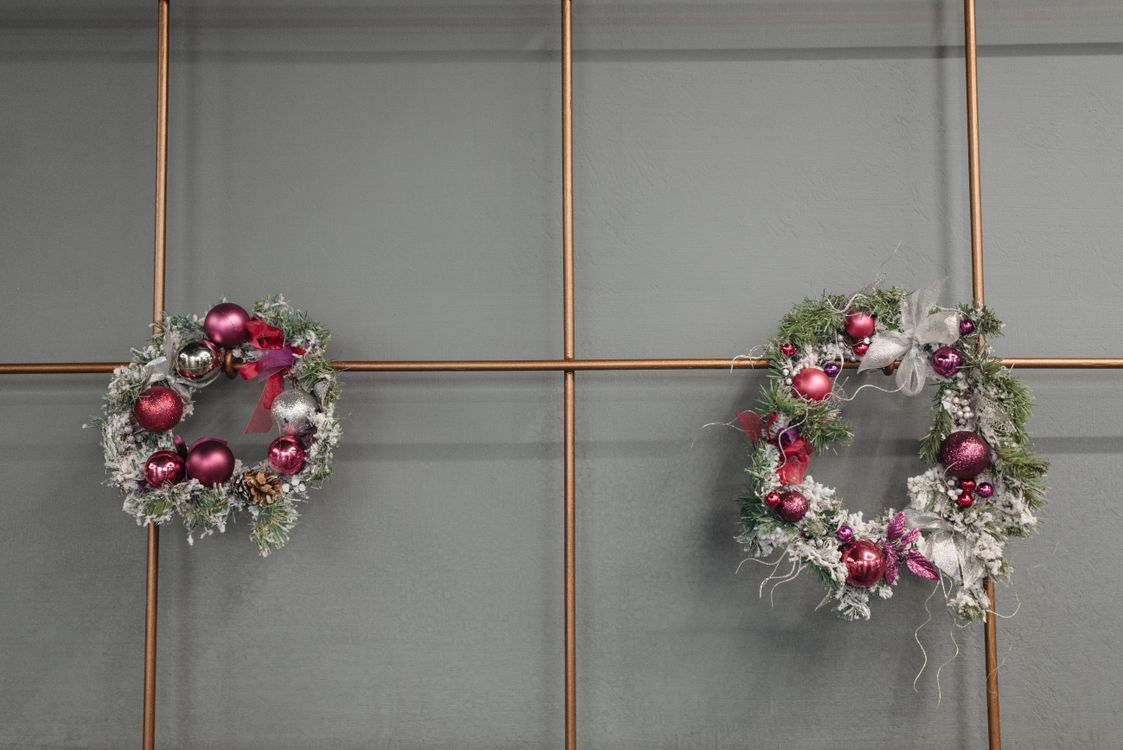
The traditional wreath is a circle of plain greenery, fir, pine, or a convincing mixture, finished with one red bow and nothing else competing. Its restraint is the point: on the door, on the mantel wall, or above a sideboard, it is the scheme’s logo, and logos do not need garnish.
Size it generously, 45 to 60 cm for a door, and wire the bow at the top or bottom with tails long enough to read from a distance. A small neat wreath with a small neat bow looks like it is apologizing; the classic version never does.
If the wreath carries anything beyond greenery and the bow, let it be pinecones or red berries, the two traditional additions. Both stay inside the fence, both weather well, and neither will date the wreath the way novelty additions do by the second December.
5. Run Garland Wherever the Room Has a Line
Mantel, stair rail, door frame, the top of the dresser: traditional rooms put garland on every horizontal line the architecture offers, and the repetition of green from surface to surface is what makes the house feel decorated rather than dotted. Use one garland type throughout so the lines match.
Dress the garlands identically and sparingly: warm lights woven through, red berries or small red baubles in clusters, a bow where a garland ends or turns a corner. The mantel garland, as the room’s centerpiece, may carry the candles of idea 6 as well; the full method is in our guide to decorating christmas mantel ideas.
Real greenery mixed into faux garland lifts the whole run: offcuts from the tree, a few branches wired in at intervals, replaced as they dry. The mix defeats the uniformity that gives plastic away, and the scent does the rest.

6. Group Red Candles Like You Mean It
Red pillar candles are the traditional scheme’s fire: grouped in threes and fives on the mantel, the sideboard, and the table, in brass or wooden holders, they put the accent color at flame height where it glows against the green around it. One red candle is a leftover; a group is a tradition.
Vary heights within each group and keep the groups at the room’s natural gathering points rather than spreading singles along every surface. Candlelight in a traditional room should pool where people gather, the same lighting logic as any warm room, executed in red wax.
Use LED versions in the garland and anywhere near greenery, and keep real flames for the table and the mantel’s clear center. The scheme is old; the fire safety does not have to be.

7. Build One Corner Vignette With Wreath, Gifts, and Green
Every traditional room deserves one composed corner: a small wreath on the wall or a chair back, wrapped gifts in the scheme’s papers below it, a lantern or candle group beside them, greenery tying it together. It is the spot that gets photographed, and it proves the scheme was arranged rather than merely applied.
Compose it like a still life: tallest element at the back, the wreath above, gifts stepped down, the light source low and to one side. Keep the palette fenced and let the shapes vary, because within two colors, shape and height are the whole composition.
Place the vignette where the room’s traffic naturally pauses, beside the fireplace, at the end of the sideboard, by the chair where people sit with coffee. A vignette nobody stands near is a display case; one in the room’s life becomes part of its December.

8. Keep the Decorating Itself a Family Ritual
Traditional decor’s secret ingredient is that it is done together and done the same way each year: the same boxes, the same order, the tree decorated by the whole household with the same arguments about the same ornaments. The ritual is not a side effect of the style; it is the style’s source, and rooms dressed this way carry an ease that styled rooms rarely fake.
Protect the ritual practically: ornaments stored by tree zone in labeled boxes, the unbreakable ones in the box children open first, the inherited glass in its own padded case. A ritual that begins with breakage and hunting for hooks begins badly every year.
Let the family pieces override the fence when they must. A child’s handmade ornament in a wild color belongs on the traditional tree precisely because tradition means the family’s history outranks the scheme, and one joyful exception proves the rule everywhere else.

9. Repeat the Wreath Motif Through the House
One wreath is a decoration; wreaths repeated, on the door, over the mantel, on interior doors, at the tops of windows, become the house’s rhythm. Traditional schemes are built on motif repetition more than on variety, and the wreath is the motif that scales from full-size at the door to small versions on cabinet doors and chair backs.
Keep them all the same family: same greenery, same bow style, sized to their panels. A house where every wreath matches reads as deeply intentional, and the cost is only discipline, since plain wreaths are the cheapest kind.
Small wreaths, 15 to 20 cm, earn their place on the backs of dining chairs with ribbon hangers for a hosted dinner. It is the oldest entertaining trick in the scheme and it still makes guests feel the evening was composed for them.

10. Dress the Sideboard Like an Altar to the Season
The sideboard or dresser is the traditional room’s second stage after the mantel: a garland along its back edge, the candle group at one end, the best bowl filled with red ornaments or pinecones at the other, and the family’s ceremonial pieces, the tureen, the cake stand, the inherited figurine, in between.
Build it in a triangle: height at the back with the garland and any framed piece, the candle group mid-height, the bowl low at the front. A flat line of objects on a sideboard reads as a shelf in a shop; the stepped arrangement reads as a composition.
This is also where the drinks and the serving pieces live at entertaining time, so leave the middle third genuinely clear. A sideboard dressed edge to edge will be undressed by the first tray that needs landing, and the composition will spend the party in a heap at one end.

11. Let Red and White Textiles Do the Soft Work
The scheme’s textiles, plaid throws and cushions, a checked table runner, red and white bedding in the guest room, carry the colors onto every soft surface and make the rooms feel wrapped rather than decorated. Plaid is the traditional pattern, in red-green for full commitment or red-cream where the room needs calming.
Buy textiles in the scheme once and store them as a set; they are the fastest layer to deploy in November and the least breakable thing you own. A sofa with the plaid throw and two red cushions announces the season before a single ornament is hung.
Keep the everyday textiles underneath neutral so the swap is additive. The traditional scheme should take an afternoon to install, not a weekend, and textiles that replace rather than layer double the work at both ends of the season. A plaid Christmas throw in the classic red and green check is the single piece that does the most of this work per dollar.

12. Carry the Scheme Outside the Front Door
Finish where visitors begin: the garland on the gate or the porch rail, the wreath on the door, warm light in a lantern. A traditional scheme that stops at the threshold wastes its best quality, instant recognition, on the people who see the house from outside, which is most of the people who will ever see it.
Repeat the indoor grammar exactly: same greenery, same red, same bow. The street should be able to guess the living room from the gate, because that continuity is what makes a traditionally decorated house feel like one thought rather than two projects.
Use the sturdy versions outside, wired firmly, weatherproof where it matters, and accept that exterior pieces age faster. The scheme’s classics are all replaceable, which is the final practical virtue of tradition: nothing in it is precious, and everything in it is loved.


