
A small entryway is not a room; it is a pause between the street and the home, sometimes no more than the width of the door’s swing. Decorating it like a room fails, because there is no floor for furniture and barely a wall for a picture. The entries that work treat the wall as the furniture: everything hangs, hooks, or folds, and the floor stays a path rather than a storage area with a door in it.
The test for every idea below is the door swing and the shoulder check. If an arriving person with a bag and a coat cannot turn around without touching your styling, the styling is too big, whatever it looks like in a photo. Small entries succeed by being deliberate at miniature scale: one hook row, one mirror, one light, each chosen instead of accumulated.
Work in this order: storage first, because an entry that cannot swallow a coat will never look tidy, then light and reflection, then the one or two soft touches that make the pause feel like a welcome rather than a corridor.
1. Let a Row of Hooks Be the Whole System
When there is no room for a hall tree or a console, a row of hooks at shoulder height is the entry: coats, bags, hats, and the dog lead all live on one line, visible and reachable, and the wall does the job furniture cannot. Five or six hooks on a mounted board reads as intention; single hooks dotted along the wall reads as improvisation.
Mount the board into studs or with proper wall anchors, because hooks fail by pulling out under a wet winter coat’s weight, not by breaking. Set the row at 160 to 170 cm for coats, and add a second lower row at 100 cm only if children or short coats genuinely need it.
Keep two hooks permanently empty. A hook row at full capacity looks and works like a jumble sale; the empty hooks are the visual rest that makes the system look styled, and they are where guests’ coats go, which is the entire point.
2. Tuck in One Seat That Earns Its Footprint
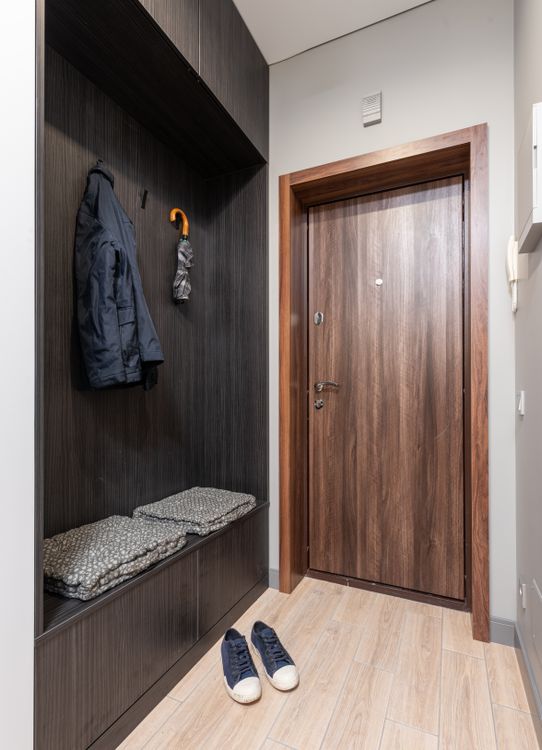
Sitting to put on shoes is the difference between an entry that works and one that merely stores. In a barely-a-wall entry the seat must be miniature: a small bench the width of the wall stub, a stool that slides under the hook board, or a folding seat that hangs flat. If it cannot fit inside the door’s swing zone’s leftovers, it does not fit.
Choose a seat with a second job: a bench with a shelf beneath for shoes, a lidded stool that swallows gloves and scarves, a trunk that holds the winter overflow. Single-purpose furniture is a luxury of large halls.
Height matters more than width: a seat top near 45 cm suits most adults for shoe work. A beautiful bench at the wrong height will be walked around rather than sat on, and a walked-around object in a tiny entry is an obstacle with good intentions.

3. Keep the Palette Pale So the Space Reads Bigger
A small entry has no spare visual room, so color discipline does the enlarging: pale walls, a light door interior if you can paint it, and hardware and hooks in one metal. Every dark or contrasting element in a tiny space is a full stop the eye must process, and three full stops make a corridor feel like a closet.
This does not mean white everything. A pale warm grey, a soft cream, or the lightest version of the color used in the room beyond all keep the entry connected to the home while bouncing its limited light. The door’s inside face in a slightly deeper tone of the same family gives the pause a boundary without shrinking it.
Save strong color for the one textile, the runner of idea 4 or a cushion on the bench, where it is read as an accent rather than a wall closing in. In small spaces, accents are where personality is allowed to live.

4. Run a Runner Down the Strip to Give It Direction
A narrow entry is a strip, and a runner is how a strip becomes a place: it points from the door into the home, catches the grit at the threshold, and adds the layer of pattern and warmth that walls too small for art cannot provide. It is the one decorative element that tiny entries can always afford, because it occupies no one’s way.
Size it to the strip, not to the furniture that is not there: leave 5 to 10 cm of floor visible on each side, and run it from just inside the door to the point where the entry becomes the next room. A runner that stops halfway reads as a mat that escaped; the full run reads as a route.
Choose washable, low-pile, and mid-toned. The entry runner lives the hardest life of any textile in the house, and a pale high-pile runner in a doorway is a cleaning schedule disguised as decor.

5. Give One Wall to Closed Storage
Open hooks handle the daily coat; everything else, the shoes not in season, the bags, the umbrellas, the hallway overflow, needs a door to close on it. In a small entry, one tall shallow cabinet or a wardrobe section on the longest wall swallows the clutter that otherwise colonizes the floor, and its flat front reads as wall, not furniture.
Depth is the discipline: 30 to 35 cm holds coats on hooks and shoes in rows, and keeps the passage clear. A standard 60 cm wardrobe in a narrow entry eats the corridor it was meant to serve, and the door swing will fight the front door’s for the rest of its life.
Fit the inside before admiring the outside: a rail or hooks at the top, shoe shelves at the bottom, one shelf for the small things. A beautiful cabinet with an unplanned interior becomes a cupboard of regrets by February.

6. Light It Warmly So It Feels Like a Room, Not a Passage
Small entries are usually lit by one ceiling bulb doing its worst. A warm light at a lower height, a small wall lamp, a lit niche, or a lamp on the storage cabinet if there is a surface, changes the pause from corridor to room, because rooms are lit in pools and passages are lit from above.
Temperature is the whole trick in a space this size: 2700K warm white, and the entry feels like the home’s beginning. A cool bulb makes the same space feel like a stairwell in an office block, no matter how good the hooks are.
If wiring is impossible, a rechargeable or plug-in wall light beside the mirror position gives the low glow without an electrician. Charge it on the same rhythm as other household things and it becomes as reliable as a fixture.

7. Make the Door Itself the Decoration
When the walls are too small for art, the door is the largest canvas the entry owns: its color, its hardware, and one seasonal note, a wreath on a hook, a hanging ornament, a painted interior face, carry the whole decorative load, and they do it on a surface that was already there.
The interior face of the front door is yours to paint even in many rentals with permission, and a considered color there, deep green, warm black, the home’s accent, turns the entry’s plainest moment into its strongest. Keep the walls pale around it under idea 3’s rule and the door becomes the accent the space was missing.
Whatever hangs on the door must survive the door: fixings rated for movement, nothing that swings into the frame or rattles at every closing. A door decoration that announces itself by noise will be removed within the week, by you, at midnight.

8. Take Storage Vertical: Racks, Rails, and the Door’s Back
The floor of a small entry is fully employed by feet; everything else must live on vertical surfaces. A wall rack for bags and hats, a rail with S-hooks for the daily rotation, and over-door hooks on the back of the front door or a cupboard door add a second storage wall that did not exist at breakfast.
Group by frequency: the daily coat and bag at hand height on the main hooks, the occasional items high, the seasonal ones in the closed storage of idea 5. Vertical storage fails when the thing needed daily is the thing stored highest, so the ladder logic has to be honest.
Keep the racks to one wall so the other can stay empty. In a tiny space, one furnished wall and one bare wall reads as calm; two furnished walls read as a corridor in a shop’s stockroom. The same restraint powers the layouts in small apartment living room ideas, where every room is one wall too small.

9. Add One Living Thing and Call It Finished
The last small entry needs exactly one soft note: a small plant on a wall shelf or hanging from a hook, a stem in a narrow vase on the storage cabinet, something alive that tells arrivals this pause is part of a home. Choose by the entry’s real light: pothos and snake plants forgive the dark corners most entries are.
Keep it out of the coat zone and the door’s swing, high or to the side, in a pot that cannot be knocked by a bag strap. A plant on the floor of a tiny entry is a spill waiting for its moment; the same plant on a wall bracket is decor.
Then stop. A barely-a-wall entry is finished when the coats hang, the shoes hide, the light is warm, and one green thing is alive in it. Every object beyond that list makes the pause smaller, and the whole art of the small entry is knowing that finished is a place, not a pile.


