

I remember walking into a friend’s bedroom a few years ago and stopping in the doorway. Not because it was expensive or dramatically designed but because it felt so completely right. Warm without being overdone. Personal without being cluttered. The kind of space you immediately want to sit down in and stay for a while. I stood there longer than was probably polite, genuinely trying to work out what made it feel so different from my own bedroom at home.
The answer, as I slowly pieced it together, was not any single thing. It was the accumulation of small, honest decisions made consistently in one direction. The way the lamplight fell at exactly the right level. The texture of the rug underfoot. The particular amber tone of the walls. A few personal objects that clearly meant something real. Nothing was trying too hard. Everything belonged.
I went home and looked at my own bedroom with completely different eyes. I had been making decorating decisions without a clear direction. Some choices toward minimalism, some toward warmth, some toward nothing in particular. The room reflected that inconsistency. It was not bad. It just had no feeling.
These 19 ideas are the ones that helped me find that feeling and build toward it deliberately.
1. Recreate the Feel of a Sleeping Nook
There is something deeply primal about the appeal of a sleeping nook. A space just large enough to sleep in, surrounded on multiple sides by soft walls or curtains or architectural enclosure, triggers a sense of shelter and safety that an open bed in an open room rarely achieves in the same way.
You do not need to build anything structural to recreate this feeling. A low bed frame pushed into the corner of the room with walls on two sides already creates a version of it. Curtains hung from the ceiling on the open sides of the bed complete the effect. The bedroom shifts from an open room containing a bed to a room built around the experience of sleeping in it.
Key Design Tips
- Push a low bed frame into a corner to naturally create walls on two sides of the sleeping area
- Hang lightweight curtain panels from a ceiling-mounted track on the open sides for enclosure
- Use the same fabric for curtains and bedding for a seamlessly immersive nook feeling
- Keep nook lighting very warm and very low, a small wall-mounted light or string lights work best
- A nook bedroom benefits from the rest of the room being kept minimal to let the sleeping area breathe

2. Choose a Low Platform Bed
The height of a bed above the floor changes the entire visual energy of a bedroom in ways that most people have never consciously considered. A high bed frame elevates the sleeping area and creates a more formal, traditional bedroom. A low platform bed does the opposite. It lowers the room’s visual center of gravity, makes the ceiling feel higher, and creates a relaxed, grounded quality that suits a cozy bedroom aesthetic deeply.
Low beds also make layered bedding look more beautiful. The weight and drape of linen, cotton, and knit throws falls more naturally from a lower frame. The bed looks like something to sink into rather than something to climb up onto.
Key Design Tips
- Platform beds work best in rooms with reasonably high ceilings as they exaggerate vertical space beautifully
- Choose a frame in natural timber, upholstered linen, or simple matte black for a clean low-profile look
- Layer bedding generously on a low platform bed as the low frame makes textural depth more visible
- Keep furniture around a low bed at a similarly low scale to maintain a consistent grounded atmosphere
- A low platform bed pairs especially well with floor-level lighting, baskets, and plants nearby

3. Dress the Room in Warm Honey and Amber Tones
Warm honey, amber, golden ochre, and burnished orange-brown tones create a bedroom atmosphere that feels simultaneously energizing and deeply comfortable. These are the tones of late afternoon light and firelight. The tones that instinctively signal warmth and safety before a single conscious aesthetic decision is registered.
Building a bedroom palette around honey and amber does not mean every surface needs to be golden. It means introducing these tones consistently through wall paint, textiles, wooden furniture, lampshades, and decorative objects so that the room carries a warm luminosity throughout. Even in rooms with limited natural light, a honey and amber palette creates the impression of a sun-warmed space.
Key Design Tips
- Warm amber walls in eggshell or matte finish set the tone for the entire room from the first decision
- Choose lampshades in amber glass, warm honey linen, or burnished brass to reinforce the tonal palette
- Natural honey-toned timber furniture in light oak or pine complements amber walls most beautifully
- Layer warm ochre and golden mustard textiles alongside neutral creams to prevent the room feeling too saturated
- Amber glass vases and objects catch lamplight beautifully and contribute warmth even in small quantities

4. Introduce Patterned Vintage-Inspired Textiles
A bedroom built entirely in solid neutrals can occasionally feel tonally beautiful but slightly anonymous. Patterned textiles introduce personality, history, and a sense of collected warmth that solid fabrics alone cannot provide. Vintage-inspired patterns especially carry an emotional resonance that contemporary geometric prints often lack.
A kilim-style rug at the foot of the bed. A suzani or ikat-patterned cushion among solid linen ones. A vintage-inspired embroidered throw folded at the foot of the mattress. These pieces do not overwhelm a neutral bedroom. They anchor it. They give the eye a place to rest that is interesting without being demanding, and they introduce the quality of something found rather than purchased.
Key Design Tips
- Limit patterned textiles to one or two key pieces to prevent the room feeling visually busy
- Vintage kilim rugs work beautifully on bedroom floors and add warmth beneath a low platform bed
- Mix one patterned cushion among three or four solid ones for an effortlessly collected look
- Earthy red, warm terracotta, deep navy, and golden ochre are the most cozy vintage textile tones
- A single patterned textile piece in an otherwise neutral room creates a natural focal point organically

5. Commit to an All-Linen Bedroom Aesthetic
Linen is the fabric that most consistently delivers the quality of effortless cozy warmth that people spend significant time and money trying to achieve with other materials. It wrinkles beautifully. It softens with every wash. It carries a lived-in texture from the very first use that makes a bed look genuinely comfortable rather than perfectly staged.
An all-linen bedroom, where the bedding, curtains, cushion covers, and even some upholstery all share the same natural fabric, creates a unified atmosphere of relaxed, organic warmth. The slight variation in how linen behaves across different pieces and manufacturers adds a tonal richness that matching synthetic sets never achieve. It is the fabric equivalent of a room that has always been there.
Key Design Tips
- Invest in genuine washed linen rather than linen-blend fabrics for the most authentic texture and drape
- Pre-washed linen bedding has a softer feel from the start without requiring multiple machine cycles
- Layer linen in two or three tones, warm white, oatmeal, and pale flax, for a natural tonal bed
- Linen curtains in a similar tone to the bedding create the most seamless, cohesive all-linen look
- Linen softens and improves significantly with age, making it one of the best long-term bedroom investments

6. Create Visual Calm With Symmetrical Bedside Styling
Symmetry in a bedroom is one of the quietest and most effective tools for creating a sense of order, calm, and considered design. When both sides of the bed are styled with matching or closely complementary elements, the sleeping area gains a visual stability that reads instantly as intentional rather than assembled.
Matching lamps. Matching nightstands. Matching small plants. The symmetry does not need to be rigid or identical to work. Two lamps of the same style but slightly different sizes. Two plants of the same species but at different growth stages. Two nightstands of the same material but different designs. The pattern creates calm. The slight variation within it keeps the room from feeling corporate.
Key Design Tips
- Start with matching lamps on each side as the most impactful symmetrical bedside investment
- Matching nightstands do not need to be identical in model, the same material and scale is enough
- Use a small tray on each nightstand to create a visual anchor point that ties both sides together
- Mirror the general styling of each side without copying it exactly for a natural, considered symmetry
- Symmetrical bedside styling makes the entire room feel more finished and composed instantly

7. Add a Warm Electric Fireplace
A fireplace in a bedroom changes the atmosphere of the space at a fundamental level. The presence of fire, even a simulated one, triggers something deep and instinctive about warmth, safety, and shelter. It changes the room from a place for sleeping into a place for lingering, for reading, for being genuinely unhurried.
Modern electric fireplaces have improved dramatically. The better models have realistic flame effects with amber and orange tones that create genuine visual warmth without producing heat when it is not needed. Built into a simple surround or positioned as a freestanding unit, an electric fireplace becomes the room’s natural focal point and the one detail that elevates the cozy atmosphere above every other option.
Key Design Tips
- Position the electric fireplace on the wall directly opposite the bed for maximum visual impact from the sleeping position
- Choose a model with adjustable flame color settings, amber and orange tones read most naturally warm
- A simple white or warm grey surround suits most bedroom styles without competing with the flame effect
- Mount a wooden mantle above the fireplace for a shelf to style with candles, plants, and personal objects
- An electric fireplace with a built-in timer maintains the cozy atmosphere without requiring manual adjustment each evening

8. Use Soft Arched Mirrors for Organic Shape
Rectangular mirrors are the default in most bedrooms and they function perfectly well. But arched mirrors introduce a softness of form that rectangular alternatives simply do not carry. The curved top of an arched mirror references organic shapes: doorways, window frames, architectural elements that feel human in their proportions and warm in their associations.
A tall arched mirror leaning against the wall beside the wardrobe. A smaller arch-topped mirror above the dresser. Even a pair of smaller arched mirrors grouped together on one wall. These pieces introduce a visual gentleness that suits a cozy bedroom aesthetic far more naturally than sharp-cornered frames, and they work beautifully in both minimal and more layered room styles.
Key Design Tips
- A tall narrow arched mirror leaning against the wall creates an editorial, effortless bedroom look
- Natural rattan, warm timber, and aged brass frames suit arched mirrors in cozy bedroom aesthetics best
- Position arched mirrors to reflect a warm light source rather than a cold window for the best atmospheric effect
- Two smaller matching arched mirrors hung symmetrically above the dresser creates a refined and considered look
- The arch shape works particularly well in bedrooms with low ceilings as it suggests vertical extension naturally

9. Style Woven Baskets as Decorative Storage
Woven baskets are one of the most undervalued decorating tools in a cozy bedroom. They solve a genuine storage problem while simultaneously contributing warmth, texture, and organic character to the space in a way that wooden boxes, fabric bins, and plastic containers never quite manage.
A large woven basket at the foot of the bed for extra throws and blankets. A medium seagrass basket beneath the nightstand for books and small objects. A pair of matching baskets on open shelves for organized storage that still looks considered and warm. Each basket adds a layer of natural texture that the eye reads as comfortable and honest, which is exactly the quality a cozy bedroom needs at every level.
Key Design Tips
- Choose baskets in natural seagrass, rattan, water hyacinth, or woven cotton for the warmest effect
- Vary basket sizes across different positions in the room for a naturally collected rather than matching look
- A large floor basket at the foot of the bed is both the most practical and most visually impactful placement
- Lidded baskets on open shelves keep storage concealed while contributing the texture of the basket itself
- Use consistent basket tones throughout the room rather than mixing very different colors or weave styles

10. Build a Tonal Sage Green Bedroom
Sage green is perhaps the single most consistently successful wall color for a cozy bedroom. It sits in a unique tonal position that is simultaneously warm and cool, earthy and fresh, neutral enough to recede and distinctive enough to give the room a genuine character of its own.
Sage green walls with cream linen bedding, natural timber furniture, and warm brass or rattan accessories create a bedroom palette that feels timeless rather than trendy, grounded rather than cold. The color works in both strong morning light and warm evening lamplight, shifting between a fresh earthy green during the day and a deeper, moodier tone as the lamps come on in the evening. Both versions are genuinely beautiful.
Key Design Tips
- Choose sage green with warm grey-green undertones rather than cool blue-green for the coziest result
- Pair sage walls with cream and warm white rather than bright white for a softer tonal relationship
- Natural timber furniture in walnut, oak, or pine complements sage green most naturally and warmly
- Warm brass, antique gold, and rattan accessories all work beautifully against a sage green backdrop
- Test sage green paint in the specific room’s light as the tone shifts significantly between different light conditions

11. Use a Shaggy Rug for Maximum Softness
There is a specific quality of physical comfort that only a deep-pile shaggy rug provides. The sensation of stepping onto a genuinely soft, yielding surface first thing in the morning is one of those small daily pleasures that costs little but contributes meaningfully to how a bedroom feels to live in rather than simply to look at.
A large cream, warm ivory, or oatmeal shaggy rug beneath and beside the bed transforms the floor into a surface that invites bare feet and slow mornings. It adds warmth at the level where warmth is most physically experienced. And visually, a deep-pile rug adds a layer of softness and generosity to the floor that thinner, flatter alternatives simply cannot replicate from across the room.
Key Design Tips
- Choose a shaggy rug pile height of at least 4 to 5 centimeters for the most genuinely soft underfoot experience
- Cream, warm ivory, and oatmeal shaggy rugs suit most cozy bedroom color palettes beautifully
- Use a good quality rug pad beneath a shaggy rug to prevent movement and extend the rug’s lifespan
- Vacuum shaggy rugs gently with a suction-only setting to maintain the pile without matting it down
- A shaggy rug combined with a smaller textured woven rug layered on top creates the richest floor composition

12. Use a Low Bookcase as a Headboard Backdrop
A low bookcase positioned directly behind the bed, running the full width of the headboard wall, creates one of the most personal and characterful bedroom backdrops available. It is functional, deeply personal, and visually rich in a way that a painted wall or even a statement headboard alone cannot replicate.
The books themselves contribute color, texture, and the unmistakable warmth of a space that belongs to a reader. The objects interspersed between them, a small plant, a framed photograph, a ceramic object, add layers of personal detail that styled shelves in other parts of the room often lack because of the unique intimacy of their position directly behind where someone sleeps each night.
Key Design Tips
- Choose a bookcase height that sits at mattress level or slightly above for the most grounded proportional look
- Arrange books in a combination of upright and horizontal stacks for a natural, lived-in appearance
- Intersperse small personal objects between book groupings for warmth and visual rhythm
- Keep the bookcase palette broadly neutral with occasional warm accent tones from book covers and objects
- Use warm bedside lighting that illuminates both the bed and the bookcase backdrop simultaneously for evening atmosphere

13. Bring in Warm Amber Glass Objects
Amber glass has a specific quality of warmth that no other material quite replicates when lamplight passes through it or rests upon it. A warm amber glass vase catching the bedside lamp glow. A small amber glass bottle on the dresser holding a dried stem. An amber glass candleholder clustering with others on a wooden tray.
These small glass objects introduce a warmth and luminosity to the room that feels genuinely different from ceramic or timber accents. When lamplight hits amber glass, it creates small moments of warm golden light that contribute to the room’s overall glow in a subtle but noticeable way. They are quiet additions that earn their place through the quality of light they bring rather than through scale or visual dominance.
Key Design Tips
- Group two or three amber glass objects together rather than placing them individually across the room
- Amber glass candleholders on a wooden tray create a beautiful warm cluster on the dresser or nightstand
- Vary the shape and size of amber glass vessels for a more natural, collected arrangement
- Position amber glass objects near warm light sources so they catch and refract the glow effectively
- Amber glass pairs most beautifully with natural timber, warm brass, and terracotta accents

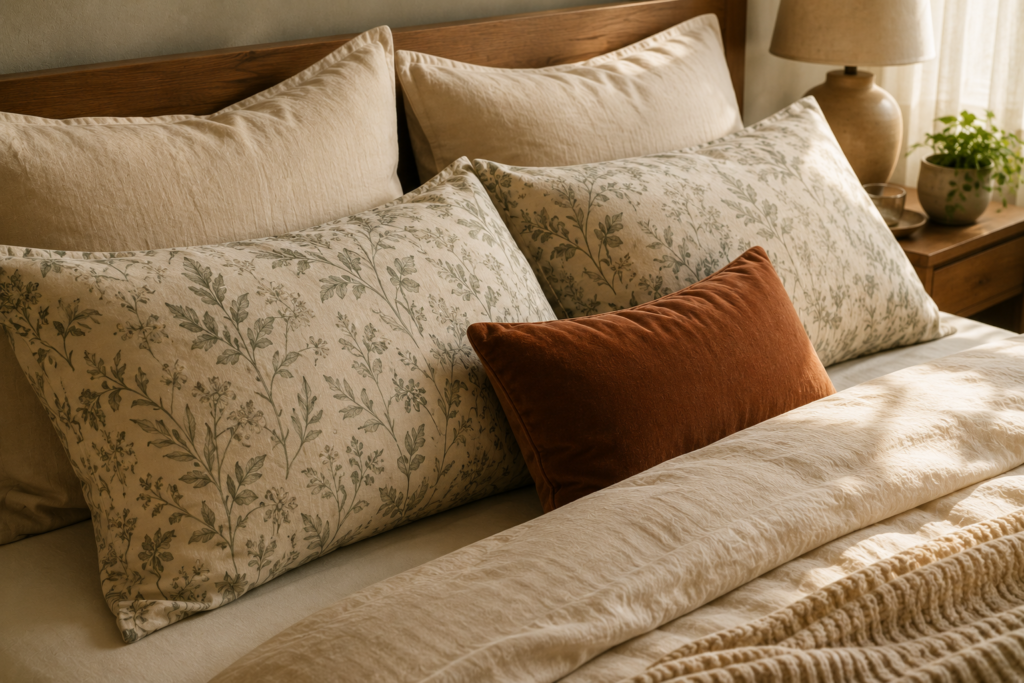
14. Use Pillowcases as a Pattern Statement
Most people focus on the duvet or throw as the statement textile on the bed and treat pillowcases as purely functional. But pillowcases sit at the most visible part of the bed, directly behind and framing the pillow arrangement, which makes them one of the most impactful pattern opportunities in the bedroom.
A set of printed pillowcases in a soft floral, a subtle stripe, or a quiet abstract pattern among otherwise solid bedding introduces personality and visual interest right at the center of the bed’s composition. It is a low commitment way to add pattern to a room that feels safe in its neutral palette but slightly lacking in character. One pattern decision, made at the pillow level, changes the bed entirely.
Key Design Tips
- Choose pillowcase patterns in muted, earthy tones that work within the existing bedroom palette
- A soft botanical print, a ticking stripe, or a simple block print all suit cozy bedroom aesthetics naturally
- Use patterned pillowcases on the sleeping pillows and keep euro shams in a solid complementary tone
- Change pillowcases seasonally for an easy and affordable way to refresh the bedroom’s atmosphere
- Linen pillowcases with a subtle printed pattern combine the best qualities of texture and visual interest
15. Embrace Cozy Minimalism
There is a version of minimalism that feels cold and clinical, stripped back to the point where the room carries no warmth or personality. And then there is cozy minimalism, which is something entirely different. Cozy minimalism keeps only the objects that genuinely contribute warmth or function and removes everything else completely.
The result is a bedroom that feels restful and uncluttered without feeling empty. Every object that remains is there because it belongs, not because it was left behind when the tidying stopped. A single plant rather than a collection. One lamp rather than three. The bed, layered and beautiful, as the room’s undisputed focus. Cozy minimalism creates breathing room around the objects that matter most, which makes everything feel warmer and more intentional.
Key Design Tips
- Start by removing everything from the bedroom and returning only what is genuinely needed or loved
- Limit decorative objects to five or six across the entire room for a truly minimal but warm result
- The bed becomes the primary and almost only visual focus in a cozy minimal bedroom, invest in it accordingly
- A single large plant works harder visually in a minimal room than a collection of smaller ones
- Negative space is an active design element in cozy minimalism, resist the urge to fill it

16. Add Rich Terracotta Accents Throughout
Terracotta is one of the most naturally cozy colors available in interior design. It carries the warmth of sun-baked earth, of Mediterranean walls and ancient pottery, of a color that has existed in human living spaces for thousands of years for very good reason. It is warm without being aggressive, distinctive without being trendy, and it pairs beautifully with almost every neutral bedroom palette.
Terracotta accents rather than terracotta walls throughout allows the tone to contribute warmth without dominating. A terracotta plant pot on the nightstand. A rust-toned cushion among cream ones. A small terracotta ceramic on the shelf. A warm rust throw folded at the foot of the bed. Each piece adds a note of earthy warmth that makes the entire room feel more grounded and inviting.
Key Design Tips
- Introduce terracotta through three or four small accent pieces rather than one single large statement
- Terracotta plant pots are the easiest and most natural starting point for this color in any bedroom
- Pair terracotta with sage green, cream, warm white, and natural timber for the most cohesive result
- Avoid bright orange or overly saturated versions, muted dusty terracotta reads most warmly and naturally
- Terracotta glazed ceramics catch warm lamplight beautifully and earn their place on any bedroom surface

17. Install Indirect LED Lighting Behind the Headboard
Indirect lighting behind the headboard is one of the most effective atmospheric lighting techniques available in a bedroom and one of the least commonly used in residential spaces outside of hotels and professionally designed interiors. A warm LED strip mounted behind the headboard panel or along the top edge of the bed frame casts a soft warm glow upward against the wall without any visible light source.
The effect is a warm halo of amber light surrounding the bed that makes the sleeping area feel like the warmest, most deliberate spot in the entire room. It works particularly beautifully in the evening when the overhead and bedside lights are dimmed and the indirect glow behind the headboard becomes the room’s primary atmospheric source.
Key Design Tips
- Use warm white LED strips rated between 2200K and 2700K for the most amber, cozy indirect glow
- Mount the strip along the back edge of the headboard panel facing the wall rather than the room
- Connect to a dimmer switch for full control over the intensity of the indirect glow
- Indirect headboard lighting works best against a matte wall surface that diffuses the glow softly
- Combine with completely dimmed overhead lighting for the most dramatic and atmospheric evening effect

18. Create the Perfect Nighttime Reading Setup
A dedicated and genuinely good reading setup in the bedroom is one of those quality-of-life improvements that reveals its value every single night. Most bedroom reading setups are an afterthought: a lamp that is too dim or angled poorly, a pillow propped awkwardly for support, a book balanced somewhere inconvenient. A considered setup changes every evening spent in the bedroom.
Good nighttime reading needs a lamp at the right height and angle, positioned beside and slightly behind the shoulder to throw light onto the page without shining into the eyes. A proper backrest, either a reading pillow or an adjustable headboard. A surface within reach for a drink and a place to rest the book. These three elements together make reading in bed one of the most genuinely pleasurable cozy bedroom experiences available.
Key Design Tips
- Choose a bedside lamp with an adjustable arm or head for the most flexible reading light positioning
- A reading pillow or large euro sham provides better back support for extended reading than standard pillows
- Keep a bookmark, reading glasses if needed, and a small notebook within easy reach on the nightstand
- Warm amber bulbs at around 2700K provide the most comfortable, least eye-straining reading light
- A small glass of water and a simple snack on the nightstand completes a proper cozy reading setup

19. Build the Room Around One Meaningful Collection
The most personally cozy bedrooms almost always contain at least one small collection of meaningful objects displayed with care. Not a curated selection of decorative items purchased together to match. A genuine collection: objects gathered over time from places visited, people loved, and experiences that mattered. Books from a specific period of life. Ceramic objects made by hand or found in markets across different years. Small artworks acquired one at a time rather than as a set.
These collections give a bedroom its specific identity. They are the thing that makes a room feel unmistakably like it belongs to one particular person. And that sense of specific, personal belonging is the deepest and most genuine form of coziness that any bedroom can achieve.
Key Design Tips
- Display the collection in one focused area rather than scattering pieces across multiple surfaces
- A small shelf dedicated entirely to the collection gives it the visual prominence it deserves
- Edit the collection occasionally, displaying the pieces that feel most current and meaningful right now
- The collection does not need to be visually cohesive to work, genuine meaning creates its own coherence
- Sharing the story of one or two pieces from the collection with guests creates one of the warmest room conversations possible


