
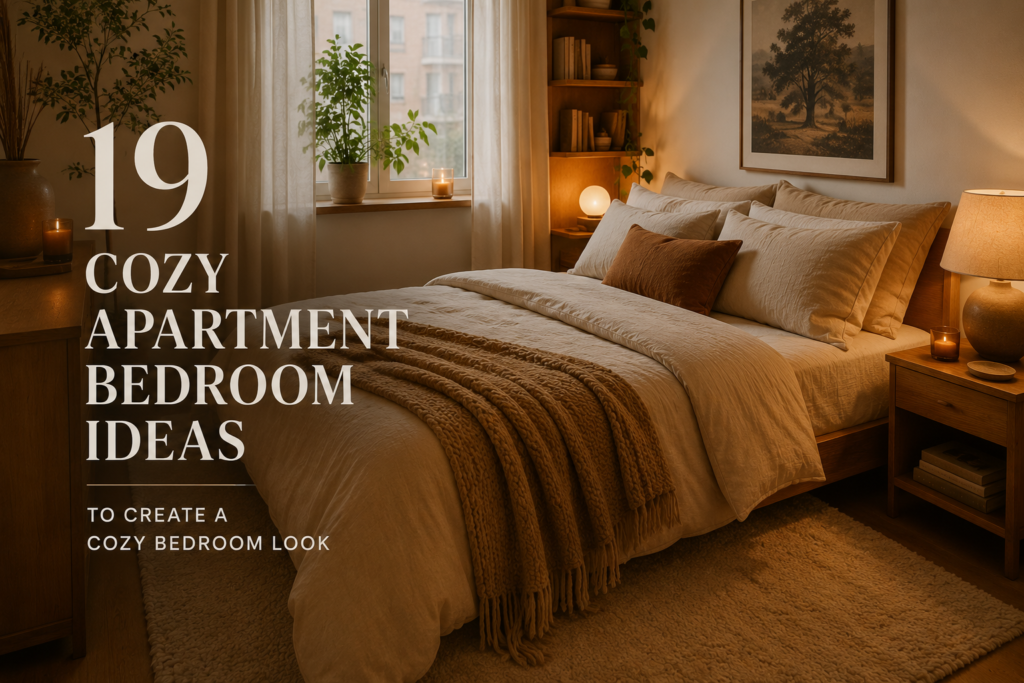
Apartment bedrooms come with a specific set of challenges that most decorating guides quietly ignore. The walls are white and you cannot paint them. The floor plan is awkward and the room is smaller than anything you ever imagined furnishing. The window faces the wrong direction. The ceiling is lower than it should be. You share walls with neighbors so thick rugs and soft surfaces are practical decisions as much as aesthetic ones.
I have decorated more apartment bedrooms than I care to count, including some that barely fit the bed and a side table. Every single one of them came with at least three of the problems listed above. And every single one eventually reached a point where it felt genuinely warm and cozy rather than like a temporary living situation waiting to be upgraded.
The trick is that apartment bedroom decorating requires a different kind of thinking. It is less about creating a dream room from scratch and more about working honestly with what exists. Making small spaces feel generous rather than cramped. Making rented white walls feel personal rather than institutional. Finding the warmth within the constraints rather than fighting against them.
These 19 ideas work specifically within the realities of apartment life. No renovation required. Most work without a single nail in the wall.
1. Invest in a Bed Frame With Built-In Storage
Storage is the defining challenge of almost every apartment bedroom. There is never enough of it and what exists is rarely in the right place. A bed frame with built-in storage, whether hydraulic lift storage beneath the mattress or deep drawers on each side of the base, solves this problem without consuming any additional floor space.
Beyond the practical benefit, a storage bed frame changes how the rest of the room functions. When the bedroom floor is no longer storing overflow items from an insufficient wardrobe, the space breathes differently. Surfaces stay clearer. The room feels less like a storage solution and more like a place designed for rest, which is the first condition for any cozy apartment bedroom.
Key Design Tips
- Hydraulic lift storage provides the most accessible and generous under-bed storage for apartments
- Choose a frame with a clean, upholstered or timber aesthetic so the storage function reads as furniture rather than utility
- Deep side drawers on a divan base are ideal for smaller apartments where lifting the mattress is impractical
- Prioritize seasonal bedding, spare towels, and rarely used items for under-bed storage to keep daily access uncluttered

2. Use Removable Peel-and-Stick Wallpaper
The single most transformative change available to a renter with white walls is removable peel-and-stick wallpaper. Applied to the headboard wall, it converts the most important surface in the room from a blank obligation into a genuine design feature, all without damaging the wall beneath or risking the security deposit.
The quality of removable wallpaper has improved significantly. Many options are genuinely difficult to distinguish from traditional wallpaper at normal viewing distance. Warm botanical prints, textured grasscloth effects, subtle geometric patterns in earthy tones, and tonal stripe designs all work beautifully in an apartment bedroom context. The headboard wall transformed by a warm wallpaper changes the entire atmosphere of the room immediately.
Key Design Tips
- Apply removable wallpaper to a clean, dry wall for the best adhesion and cleanest removal later
- Warm earth-toned botanicals, linen textures, and subtle stripe patterns suit most apartment bedroom aesthetics
- Always test one strip first and remove it after 24 hours to confirm it leaves the wall undamaged
- Measure and cut strips slightly longer than needed and trim at the ceiling and floor for a clean finish

3. Hang Curtains High and Wide on Small Windows
Small apartment windows are one of the most consistent sources of decorating frustration in rented spaces. They feel mean and inadequate and they let in less light than the room needs. The solution is not the window itself but the curtain treatment around it.
Hanging curtains from ceiling height rather than window frame height and extending the rod significantly beyond the window frame on each side makes any window appear dramatically larger and more generous than it actually is. The fabric, when drawn open, stacks entirely beside the window and reveals the full glass uninterrupted. The room gains an impression of height and light that the actual window dimensions never suggested were possible.
Key Design Tips
- Mount the curtain rod as close to the ceiling as the bracket allows, ideally within 10 to 15 centimeters
- Extend the rod at least 30 to 40 centimeters beyond the window frame on each side
- Choose floor-length curtains even for very small windows as the drop creates height regardless of window size
- Sheer linen or cotton voile maximizes light while still softening the window and creating warmth

4. Divide a Studio With a Soft Room Divider
A studio apartment bedroom that exists within a shared open-plan space has a specific problem: it has no walls of its own. The sleeping area bleeds into the living area and neither space feels properly defined or genuinely private. A soft room divider, whether fabric panels on a tension rod, a tall bookshelf, a sheer curtain track, or a folding screen, creates the boundary the bedroom needs.
The divider does not need to reach the ceiling or provide complete visual privacy to work effectively. It needs only to suggest the boundary between spaces clearly enough that the bedroom area gains its own identity and atmosphere. Once that boundary exists, even softly, the bedroom feels like a room rather than a corner.
Key Design Tips
- A ceiling-mounted curtain track with sheer or semi-opaque panels is the most flexible and elegant studio divider
- A tall open bookshelf facing the living area provides both division and practical storage simultaneously
- Choose a divider material that complements both the bedroom and living area palettes since it belongs to both
- A folding screen in natural rattan or warm timber adds character and can be repositioned easily as needed

5. Mount Nightstands on the Wall
In a small apartment bedroom where floor space is genuinely precious, traditional nightstands consume space that the room cannot afford to give. Wall-mounted shelf nightstands solve this completely. A slim floating shelf at the right height on each side of the bed provides all the practical surface of a nightstand while returning the floor space beneath to the room.
The visual effect is also significant. When the floor is continuous and uninterrupted on both sides of the bed, the room feels notably larger and less crowded than it does with furniture legs occupying that space. Wall-mounted nightstands also allow more flexibility in bed positioning since the bed can sit closer to the wall when no floor-standing furniture needs clearance beside it.
Key Design Tips
- Mount floating shelves at roughly mattress height for comfortable reach from a lying position
- Natural timber, painted MDF, and simple metal bracket shelves all work well as wall-mounted nightstands
- Keep wall-mounted nightstands styled minimally, one lamp, one plant, one tray, to prevent the small surface from feeling cluttered
- Ensure the wall fixings used are appropriate for the wall construction and confirm they are renter-safe

6. Warm Up a North-Facing or Dark Apartment Bedroom
A north-facing apartment bedroom that receives little or no direct natural light presents one of the most consistent decorating challenges in apartment living. The room feels cool and slightly flat during the day regardless of what is added to it. The solution is not to fight the lack of light but to compensate for it through warmth in every other dimension of the room.
Warm amber wall paint or removable warm-toned wallpaper rather than white or cool grey. Warm amber lighting used throughout the day as well as the evening. Deeply warm textiles in honey, caramel, and cream. Timber furniture with visible warm grain. These choices create a room that feels warm and inhabited regardless of what the light from the window is or is not providing.
Key Design Tips
- Use warm white or amber-based paint tones rather than cool grey or stark white in north-facing rooms
- Keep artificial lighting on during daylight hours in north-facing rooms to maintain warmth throughout the day
- Warm timber furniture and golden-toned accessories compensate for cool daylight more effectively than any other addition
- Mirrors positioned to reflect warm lamp sources rather than the dim window amplify warmth rather than highlighting the light deficit

7. Create a Cozy Desk Corner That Does Not Feel Like an Office
Apartment bedrooms often double as workspaces out of necessity rather than choice. The challenge is preventing the desk from colonizing the bedroom’s atmosphere and making the whole room feel like a home office. The solution is styling the desk as a warm, personal corner rather than a functional workstation.
A small timber desk against the wall with a warm desk lamp rather than a bright task light. A simple rattan or upholstered chair rather than an ergonomic office chair. A small plant, a candle, and one or two personal objects on the desk surface alongside the practical work items. Curtains or a bookshelf positioned to visually separate the desk corner from the bed when not working. The desk becomes a cozy corner rather than a productivity station intruding on the bedroom.
Key Design Tips
- Use a warm desk lamp rather than a bright cool task light to keep the desk corner feeling like the bedroom
- Choose a desk chair with a warm material, timber, rattan, or upholstered fabric, rather than a plastic office chair
- A small shelf or plant positioned between the desk and the bed creates a visual soft boundary between work and rest
- Cover or turn off the desk lamp and close the laptop when not working to allow the bedroom atmosphere to reassert itself

8. Transform Rental White Walls Without Nails
White rental walls feel institutional rather than neutral. They communicate that the space is temporary and that real decorating decisions have been deferred until later. Transforming them without damaging them requires a different toolkit: removable adhesive strips, peel-and-stick products, leaning rather than hanging, and creative use of furniture that rests against the wall.
Framed artwork leaned against the wall along a low shelf or the top of a low dresser. Large fabric panels or tapestries hung from tension rods across the wall. Adhesive picture strips for lighter framed pieces that cause no wall damage. A tall bookshelf or a large leaning mirror that occupies significant wall space without touching it as a fixture. Any of these approaches transforms the wall without a single nail.
Key Design Tips
- Command adhesive strips hold surprising weight when applied correctly to clean dry walls
- Lean large framed artwork against the wall on a shelf or dresser for a genuinely editorial look that needs no fixings
- A tall bookshelf against the white wall instantly removes a large portion of the plain white surface from view
- Fabric panels hung from a tension rod across a wall create warmth and pattern without any permanent fixing

9. Use Multi-Purpose Furniture Intelligently
Every piece of furniture in a small apartment bedroom should earn its floor space by doing more than one thing. A bed with storage beneath. An ottoman at the foot of the bed that opens for blanket storage and serves as a seat. A dresser that doubles as a desk surface. A bedside stool that provides seating and surface at once.
This principle of multi-purpose furniture is not about buying clever gadgets. It is about choosing pieces that serve genuine daily functions at two levels rather than one. The bedroom stays warmer and more personal when it is not crowded with additional furniture pieces introduced to solve individual storage or seating problems that a single more thoughtful piece could address simultaneously.
Key Design Tips
- An upholstered storage ottoman at the foot of the bed provides seating, surface, and storage in one piece
- A slim console table behind the bed serves as a shelf, a headboard, and a surface simultaneously
- Choose a bedside stool with an open lower shelf for accessible storage rather than a closed cabinet
- Measure carefully before purchasing multi-purpose pieces as scale matters significantly in small rooms

10. Use Vertical Space With Tall Slim Shelving
Small apartment bedrooms consistently underuse their most abundant resource: wall height. The floor area may be limited but the vertical space from floor to ceiling offers storage and styling potential that most bedrooms never fully exploit. Tall slim shelving units that reach toward the ceiling store more and consume less floor area than any other storage solution.
Vertically extended storage also draws the eye upward, which creates the impression of a taller room and a more generous space than the floor dimensions suggest. A tall slim shelving unit in the corner, styled with books at lower levels and plants and decorative objects at upper levels, becomes both a storage solution and a genuine design feature contributing warmth and personality to the room.
Key Design Tips
- Choose shelving units that reach at least three quarters of the ceiling height for maximum vertical impact
- Style lower accessible shelves practically and upper shelves decoratively for a warm, considered appearance
- Secure tall shelving units to the wall with an anti-tip bracket for safety, especially in rental apartments
- A tall slim shelving unit in the corner is the most space-efficient footprint for vertical storage in small rooms

11. Light a Low-Ceiling Apartment Bedroom Warmly
Low ceilings are common in apartment buildings and they create a specific lighting challenge. Standard ceiling fixtures in a low-ceiling room hang uncomfortably close to eye level when standing and draw attention to the height limitation rather than away from it. The solution is to move lighting away from the ceiling entirely.
Wall-mounted sconces, bedside lamps, floor lamps, and LED strip lighting inside shelf units all provide warm, functional light without a single ceiling fixture. When the sources of light exist at wall level and below, the ceiling recedes rather than looms. The room feels more intimate and less constrained. In a low-ceiling apartment bedroom, the complete removal of overhead fixtures and their replacement with warm lower-level sources is one of the most transformative changes possible.
Key Design Tips
- Replace or bypass ceiling fixtures with wall sconces, floor lamps, and table lamps for low-ceiling rooms
- Keep all light sources at or below eye level when standing for the most effective low-ceiling treatment
- Warm amber LED strip lights inside shelving units add beautiful ambient light without any ceiling involvement
- Avoid pendant lights in low-ceiling rooms as they reduce headroom and emphasize the height limitation

12. Make Under-Bed Space Work Hard
In an apartment bedroom where floor space is genuinely limited, the space beneath the bed is among the most valuable square footage in the room. Yet most apartment bedrooms treat it as a dumping ground for items that have no other home, which is both visually disruptive and practically inefficient.
Treating under-bed space as deliberate storage with proper organization changes the room’s relationship with that floor area. Low-profile under-bed storage boxes in matching tones create an organized system that keeps the space dust-free and the contents accessible. A bed skirt in a warm linen tone conceals storage while adding a soft visual finish to the bed base. Either approach transforms a problem area into a quiet asset that contributes to the room’s overall calm.
Key Design Tips
- Use flat under-bed storage boxes with lids in matching neutral tones for a clean, organized appearance
- A linen or cotton bed skirt conceals under-bed storage while adding warmth and finish to the bed base
- Reserve under-bed storage for seasonal items and spare bedding that are accessed infrequently
- Label under-bed storage boxes clearly so the contents remain accessible without needing to remove everything to find one item

13. Style a Small Awkward Corner Into a Cozy Destination
Every apartment bedroom has at least one awkward corner. A corner beside the wardrobe that is too small for furniture but too large to ignore. The narrow strip beside the window that does not fit a chair properly. The dead space behind the door that collects clutter by default. These corners are not problems. They are cozy opportunities waiting for the right small-scale solution.
A narrow floor cushion and a small wall-mounted shelf above it creates a minimal but functional reading corner in almost no floor space. A slim ladder shelf in the corner with a plant and a few books creates a warm styled element out of what was previously dead space. A floor lamp and a single decorative object in the corner turns empty space into a warm visual anchor point.
Key Design Tips
- A floor lamp alone in an empty corner transforms it into a warm ambient light source without any furniture
- A slim wall-mounted shelf above any corner floor space creates an instant styled surface at minimal cost
- A single large plant in a generous pot fills an awkward corner with organic warmth and no furniture required
- Measure awkward corners carefully before purchasing any furniture as even a few centimeters of width determines what fits

14. Create Acoustic Comfort With Soft Layering
Apartment living means shared walls, ceilings, and floors. The acoustic environment of an apartment bedroom is often one of its most overlooked challenges. Hard surfaces reflect sound, which makes a room feel less private, less settled, and significantly less cozy than it could be. Soft layering absorbs sound and creates an acoustic intimacy that is felt before it is consciously registered.
A large area rug that covers as much of the floor as possible. Thick curtains that absorb sound from the window wall. Multiple cushions and throws on the bed and seating. A textile wall hanging or tapestry that softens the wall behind the bed. Bookshelves filled with books. Each soft element added to the room reduces the reflective surfaces and increases the quiet, sheltered feeling that is fundamental to genuine bedroom coziness.
Key Design Tips
- A large, thick area rug is the single most effective acoustic intervention in an apartment bedroom
- Thick curtains rather than blinds absorb significantly more sound from windows and external walls
- Bookshelves act as effective acoustic diffusers and add warmth simultaneously
- A textile wall hanging on a shared wall softens both the sound transmission and the visual surface at once
15. Use a Statement Rug to Define the Space
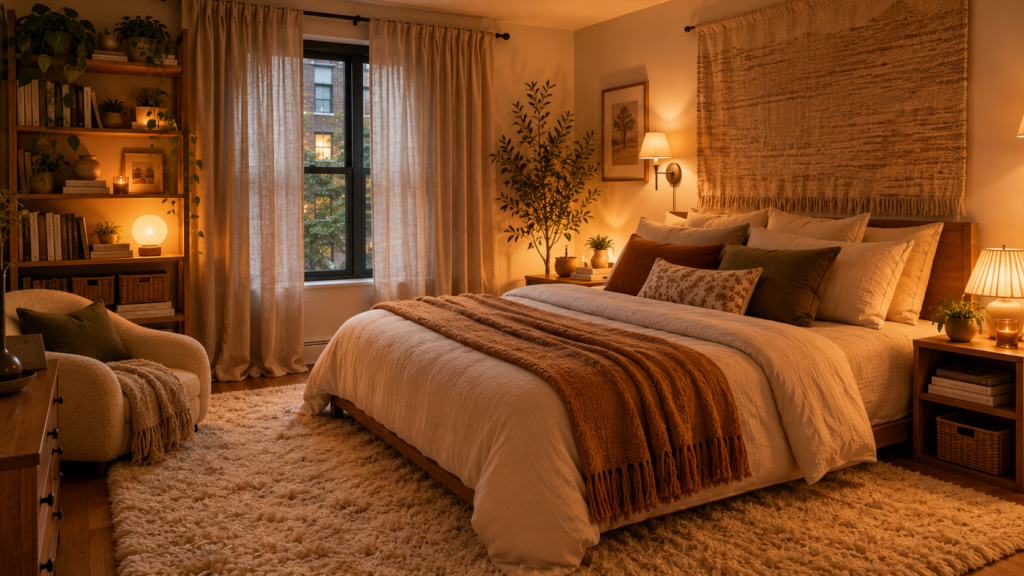
In an apartment bedroom where the floor area is limited and the room boundaries may feel ambiguous, a well-chosen area rug does important work beyond aesthetics. It defines the bedroom space clearly, anchors the furniture, and creates a visual boundary that makes the room feel purposefully designed rather than simply arranged within available space.
The rug should be generous rather than timid. A rug that is too small for the space looks like an afterthought and makes the room feel smaller rather than larger. A rug that extends confidently beyond the bed on each side and reaches toward the walls creates a defined, considered floor plane that changes the entire sense of scale in a small room. In an apartment bedroom, the rug is doing spatial design work as much as decorative work.
Key Design Tips
- Size the rug so it extends at least 45 to 60 centimeters beyond the bed on each accessible side
- In very small rooms, a rug that nearly fills the floor wall to wall creates a defined, immersive space
- Choose a rug with enough texture or tonal interest to add warmth from a distance in a small room
- A rug pad beneath the area rug prevents movement, protects the floor, and adds acoustic softness

16. Style a Daybed for a Cozy Dual-Purpose Space
A daybed is one of the most useful pieces of furniture available for small apartment bedrooms that need to serve multiple purposes. During the day it functions as a sofa, a reading seat, or a lounging surface. At night it serves as a proper single bed. In a studio apartment or a small room where the bedroom also needs to feel like a living space, a well-styled daybed eliminates the need to choose between the two.
The key to a cozy daybed is styling it to feel like neither a bed nor a sofa exclusively but something warmly between the two. Bolster cushions along the wall side, two or three throw cushions, and a generous linen throw draped across the main surface. The daybed becomes a destination in the room that works at every hour of the day.
Key Design Tips
- Bolster cushions along the wall side of a daybed create a sofa-like back support for daytime use
- Style the daybed with two to three cushions and a throw rather than full bedding for a daytime look
- A daybed positioned under a window with a view makes the most of both pieces simultaneously
- Choose a daybed frame in natural timber or simple upholstery that suits both bedroom and living space aesthetics

17. Create Warmth on a Realistic Apartment Budget
Apartment decorating often happens under real financial constraints. The temptation is to wait until a bigger budget is available before making any decisions, which means living in an unsatisfying room indefinitely. The warmest apartment bedrooms are not necessarily the most expensively furnished ones. They are the ones where the available budget was spent intentionally on the highest-impact items.
Bedding quality above almost everything else. One good lamp. One rug that fits properly. One piece of meaningful wall decor that makes the white wall feel personal. These four investments, prioritized and chosen well, create more cozy atmosphere than a room full of inexpensive items selected without focus. Budget decorating for a cozy apartment bedroom is about sequence and priority rather than spending less.
Key Design Tips
- Prioritize bedding quality over furniture quality as it is the most used and most noticed element daily
- One genuinely good lamp delivers more atmospheric improvement per dollar than almost any other purchase
- A properly sized rug that fits the space well reads more expensive than a higher-quality undersized one
- Second-hand and vintage pieces often provide the warmest character for the smallest investment

18. Make a Rented Bedroom Feel Genuinely Personal
The psychological challenge of a rented apartment bedroom is feeling permission to invest emotionally in a space that is not permanently yours. This reluctance produces rooms that look lived-in without feeling personal, comfortable without feeling warm. Overcoming it is one of the most important cozy decisions available in any rented space.
Treating a rented bedroom as a genuine home rather than a temporary arrangement changes everything about how the room is approached and experienced. Personal photographs displayed with care. Objects from meaningful places given visible positions. Textiles that have been specifically chosen rather than simply purchased. The room that results feels like it belongs to the person sleeping in it every night, which is the most genuine and durable form of coziness any bedroom can achieve.
Key Design Tips
- Display at least two or three genuinely personal objects rather than keeping everything neutral and impersonal
- Treat every decorating decision as if the apartment is a long-term home rather than a temporary stay
- Personal photographs printed and displayed without frames using adhesive strips create warmth at zero cost
- A room that feels genuinely personal always feels more cozy than one that is beautifully decorated but anonymous

19. Anchor the Room With One Signature Cozy Investment
In a small apartment bedroom decorated within the limits of a rental and a realistic budget, one signature investment rises above everything else. Not the most expensive purchase necessarily but the most considered one. The piece that was chosen with specific intent to anchor the room’s warmth and give every other decision a point of reference.
A genuinely beautiful duvet cover in high-quality washed linen. A perfectly chosen rug that fits the space exactly as it should. A lamp with a ceramic base that looks like it was made specifically for the room. These pieces do not simply improve the room. They establish its emotional tone. Every addition made after them exists in relationship to them and the room builds its cozy identity outward from their warmth.
Key Design Tips
- Identify the single most impactful element for the specific room before deciding where to invest most carefully
- A signature investment does not need to be expensive, it needs to be genuinely right for the space
- Make the signature piece the first purchase and allow it to guide every subsequent smaller decision
- A well-chosen single piece in the right position improves every other existing element around it by association


