

Dark and feminine sound like they should pull in opposite directions, and a lot of attempts at this style end up leaning too hard on one side or the other, either genuinely dark and moody but losing every trace of softness, or nominally dark but so layered with pale pink and lace that the darkness barely registers. The genuinely successful version of this style holds both qualities at once, deep, confident color paired with soft, tactile, unmistakably romantic detail, and getting that balance right comes down to a fairly specific set of choices rather than a vague aesthetic instinct.
The color itself is rarely the hard part. Most people can pick a deep, moody wall color without much trouble. What actually determines whether the finished room reads as elegant or simply dark is everything layered on top of that color, the fabric choices, the lighting temperature, the specific way metallics get introduced, the balance between soft curves and sharp lines throughout the furniture and accessories.
These eighteen ideas cover that full balance, from the foundational color and material decisions through the smaller details that ultimately determine whether a dark feminine bedroom feels genuinely elegant or just underlit. For the same moody glow in your entertaining space, see our moody living room ideas.
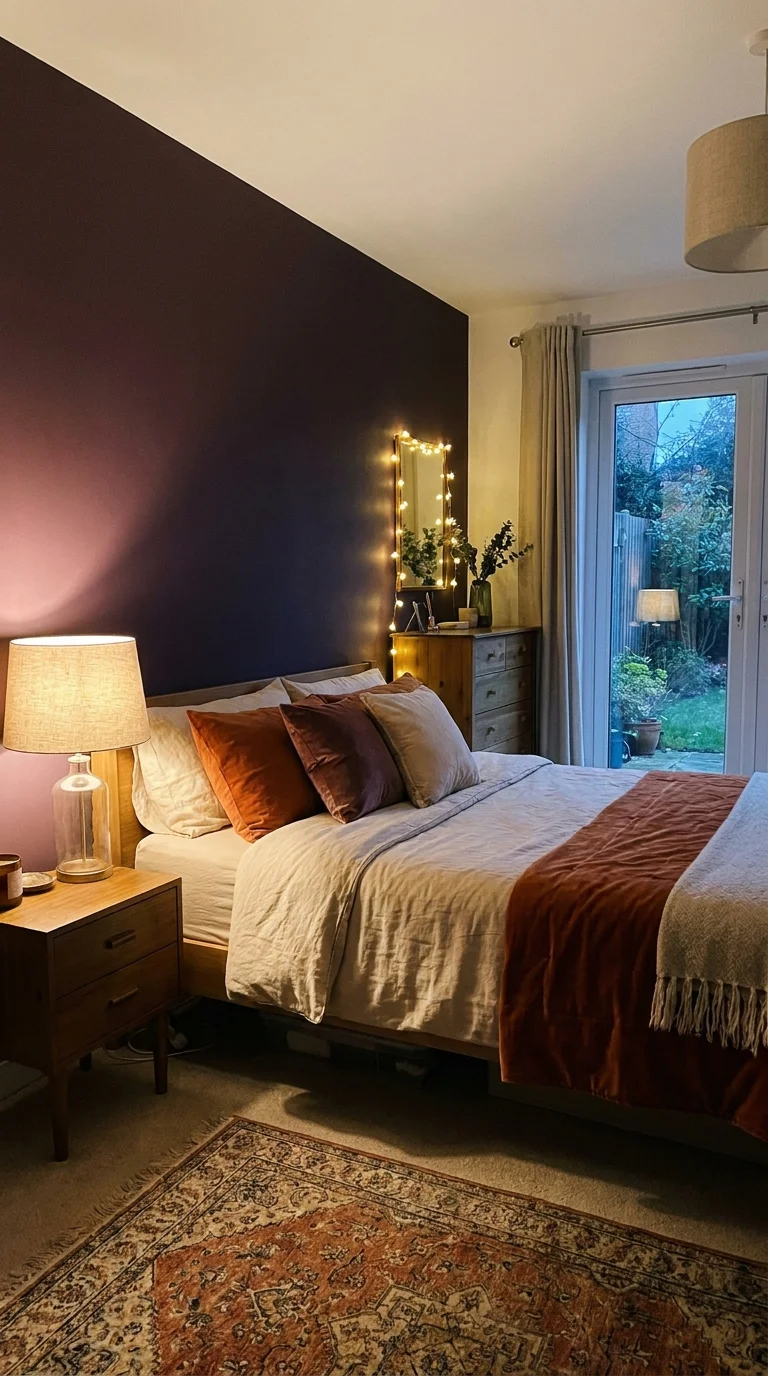
1. Choose a Deep, Warm-Undertone Wall Color
A dark wall color with a genuinely warm undertone, deep burgundy, aubergine, a rich chocolate brown, reads as considerably more elegant and more feminine than a cooler-toned dark, charcoal or navy, in most contexts, though either can work depending on the specific mood being targeted. If chocolate brown is the direction you choose, these brown bedroom ideas cover the undertones, layering, and lighting that keep it reading rich rather than muddy. Warm darks tend to pair more naturally with the soft, romantic textures this style depends on, since a cool undertone can push the overall feeling toward moody-masculine rather than moody-feminine, even when every other decorating choice remains identical. If you want to carry this moody palette beyond the bedroom, our dark moody bathroom ideas show how deep tones work in wet spaces too.
Testing the actual color in the room matters considerably more with a genuinely dark, saturated wall color than it does with a lighter one, since dark colors shift noticeably under different lighting conditions throughout the day. A color that reads as rich and warm in a paint swatch can look nearly black under limited natural light, or unexpectedly purple or brown depending on the specific undertone and the room’s actual light exposure.
2. Layer at Least Three Distinct Soft Textures
Velvet, silk, and mohair each carry a specific tactile softness that reads as unmistakably feminine, and combining several of these textures throughout the room, a velvet headboard, silk pillowcases, a mohair throw, creates the kind of layered richness that a single fabric choice alone doesn’t achieve. This layering is what keeps a dark room from feeling austere, since the softness of the materials directly counterbalances the visual weight of the deep wall color.
Varying the specific texture within each category matters too. A crushed velvet pillow alongside a smooth velvet headboard, or a silk with a subtle sheen paired with a matte silk-blend throw, introduces variation that keeps even a texture-heavy room from feeling monotonous despite everything technically falling under the same soft, tactile category.

3. Introduce Warm Gold or Rose Gold Metallic Accents
Warm metallics, gold, rose gold, aged brass, catch and reflect available light in a way that becomes especially valuable in a genuinely dark room, adding a sense of glow and richness that a purely matte, dark space can lack. This works through lighting fixtures, mirror frames, drawer hardware, and smaller decorative objects, and consistency across these elements matters as much here as it does in any lighter room, mismatched metal finishes register as unplanned regardless of how dark or light the surrounding walls happen to be.
Rose gold specifically leans further into the feminine side of this style than a more neutral warm gold does, worth considering deliberately based on how strongly feminine versus simply elegant the finished room is meant to feel.

4. Use Warm, Low Lighting as the Room’s Primary Light Source
A dark bedroom depends more heavily on considered lighting than almost any other style, since the wrong lighting choice can make an intentionally moody room simply feel dim and underlit rather than atmospheric. Warm bulbs, generally in the 2200K to 2700K range, considerably warmer than the 2700K to 3000K typically recommended for lighter rooms, read as genuinely cozy against dark walls rather than harsh or clinical.
Multiple lower light sources, table lamps, a floor lamp, string lights or a plug-in chandelier, matter more than a single central fixture here, since layered, warm light creates the kind of romantic glow this style depends on, while a single bright overhead source flattens the room’s sense of depth regardless of how dark and considered the wall color might be.

5. Choose Bedding in Rich Jewel Tones or Deep Blush
Bedding provides an opportunity to introduce a genuinely feminine color note against the room’s darker backdrop, whether through a rich jewel tone, deep burgundy, emerald, sapphire, or a more traditionally feminine deep blush or dusty rose. This color choice should relate clearly to the wall color rather than existing as an unrelated addition, a burgundy wall paired with blush bedding, or a deep plum wall paired with jewel-toned emerald pillows, both work because the colors share an underlying warmth and depth.
Layering multiple bedding pieces in slightly varied tones within this chosen palette, rather than a single flat color throughout, adds the kind of richness that makes a dark feminine bed feel genuinely dressed rather than simply covered in one matching set.

6. Add a Statement Chandelier or Crystal Fixture
A genuinely dramatic overhead fixture, whether a full crystal chandelier or a more contemporary sculptural pendant with crystal or glass elements, introduces sparkle and light-catching detail that works particularly well against a dark backdrop. The way crystal or cut glass catches and scatters available light creates a sense of movement and glow that a plain fixture simply doesn’t achieve, and this effect becomes considerably more noticeable against dark walls than it would against a lighter, already-bright room.
This doesn’t require the largest, most elaborate fixture available. A modestly scaled chandelier or a single sculptural pendant, properly proportioned to the room’s actual ceiling height and square footage, achieves the intended dramatic effect without overwhelming a bedroom that isn’t genuinely large enough to support an oversized fixture.

7. Choose Furniture With Curved, Feminine Silhouettes
Furniture with genuine curves, a scalloped headboard, a rounded nightstand, a chair with a soft, sculptural back, introduces the kind of feminine silhouette that balances the sharper visual weight of a dark, saturated wall color. This principle extends throughout the room’s furniture choices, and even a single curved piece against otherwise straight-lined furniture does real work toward establishing the feminine half of this style’s balance.
Mixing some curved pieces with some straighter ones tends to produce a more sophisticated result than committing entirely to curves throughout, since an all-curved room can start to feel overly soft in a way that works against the moody, elegant quality this style is ultimately going for.

8. Use Sheer or Lightweight Fabric Beneath Heavier Drapery
A layered curtain approach, a sheer or lightweight fabric closest to the window with a heavier, richer drape layered over it, achieves both function and a genuinely luxurious feeling that a single fabric layer doesn’t replicate. The sheer layer allows natural light to filter through softly during the day, while the heavier outer layer, drawn at night, adds the visual richness and light-blocking function a genuinely elegant bedroom depends on.
This layered approach works particularly well in a dark feminine bedroom specifically, since it allows the room to feel appropriately moody and enclosed in the evening while still receiving genuine natural light during the day, a balance that a single heavy curtain layer alone tends to sacrifice in one direction or the other.

9. Incorporate Floral or Botanical Pattern in a Single Deliberate Dose
A dark feminine bedroom benefits from floral or botanical pattern used deliberately in one focused location, a single accent chair, a set of throw pillows, wallpaper on just one wall, rather than scattered throughout the room in multiple competing doses. This concentrated approach lets the pattern read as a genuine style statement rather than diluting its impact by spreading it too thin across too many different elements.
Dark, richly colored florals, deep burgundy blooms against a black or charcoal background, tend to suit this style better than pale, delicate florals would, since the pattern’s own color palette should generally echo the room’s overall deep, saturated tone rather than introducing an unrelated lighter note.

10. Choose a Substantial Area Rug in a Complementary Deep Tone
A thin or pale rug undermines the cohesive depth a dark feminine bedroom depends on, while a substantial rug in a complementary deep tone, whether a solid color close to the wall or a richly patterned option in a similar palette, extends the room’s overall color story down to the floor. Wool or a wool-silk blend in this darker tonal range holds color richness particularly well, developing a subtle sheen over years of use that echoes the same warm, luxurious quality established through the room’s other material choices.
Sizing follows the same principle as any bedroom rug, extending well beyond the sides and foot of the bed, generally 18 to 24 inches, so the floor feels genuinely soft and considered rather than featuring a narrow strip surrounded by hard flooring.

11. Add Candles or Candle-Style Lighting for Genuine Ambiance
Real or flameless candles introduce a specific quality of warm, flickering light that fixed lighting fixtures, however well-chosen, don’t fully replicate, and this ambiance works particularly well within the romantic, moody atmosphere a dark feminine bedroom is going for. Grouped at varying heights, on a dresser, a nightstand, a mantel if the room has one, candles add both genuine light and a sense of considered, layered styling.
Where open flame isn’t practical or desired, quality flameless candles with a realistic flicker effect achieve much of the same visual impact without the ongoing maintenance or safety considerations that real candles require, particularly worth considering for candles positioned somewhere they might be left burning unattended.

12. Introduce a Vanity or Dressing Table as a Genuine Feminine Focal Point
A dedicated vanity, even a relatively compact one, adds both real function and a strong feminine focal point to a dark bedroom. A vanity with a curved silhouette, a mirror in a warm metal frame, and a comfortable stool creates a distinct zone within the room that reads as genuinely personal and considered, beyond simply the bed and its immediate surroundings.
Lighting around the vanity mirror specifically matters for actual daily use, warm-toned bulbs positioned to illuminate the face evenly, rather than from a single harsh overhead angle, make the difference between a vanity that’s genuinely used daily and one that exists purely for visual effect.

13. Choose Nightstands With Genuine Presence, Not Just Function
Nightstands in a dark feminine bedroom benefit from real visual presence rather than existing as purely utilitarian afterthoughts, whether through a curved silhouette, a marble or stone top, or simply a scale proportionate to a substantial bed frame. Undersized nightstands can look lost against a tall, dramatic headboard, while appropriately scaled ones, generally close to or just below mattress height, maintain the sense of considered proportion this style depends on throughout.
Matching nightstands on either side of the bed reinforces the room’s overall sense of order, though a deliberately curated mismatched pair, sharing a similar tone or material family without being identical, can work well too, provided the mismatch reads as intentional rather than accidental.

14. Use Deep, Rich Artwork as a Genuine Focal Point
A single substantial piece of art, in tones that echo or complement the room’s overall dark, warm palette, does more for a dark feminine bedroom’s sense of considered style than a scattered collection of smaller pieces. Portrait work, rich botanical illustration, or abstract art in deep jewel tones all suit this style particularly well, and scaling the piece appropriately, generally spanning at least two-thirds the width of whatever furniture sits beneath it, keeps the proportion feeling deliberate rather than undersized.

15. Balance Dark Walls With at Least One Genuinely Light Element
A room built entirely from dark tones throughout, walls, furniture, bedding, textiles, can tip from moody and elegant into simply heavy without at least one genuinely lighter element providing contrast and relief. This might be pale bedding against dark walls, a cream or ivory accent chair, or simply abundant natural light during the day through appropriately layered window treatments. This single light element does considerable work toward keeping the room feeling balanced rather than oppressive.
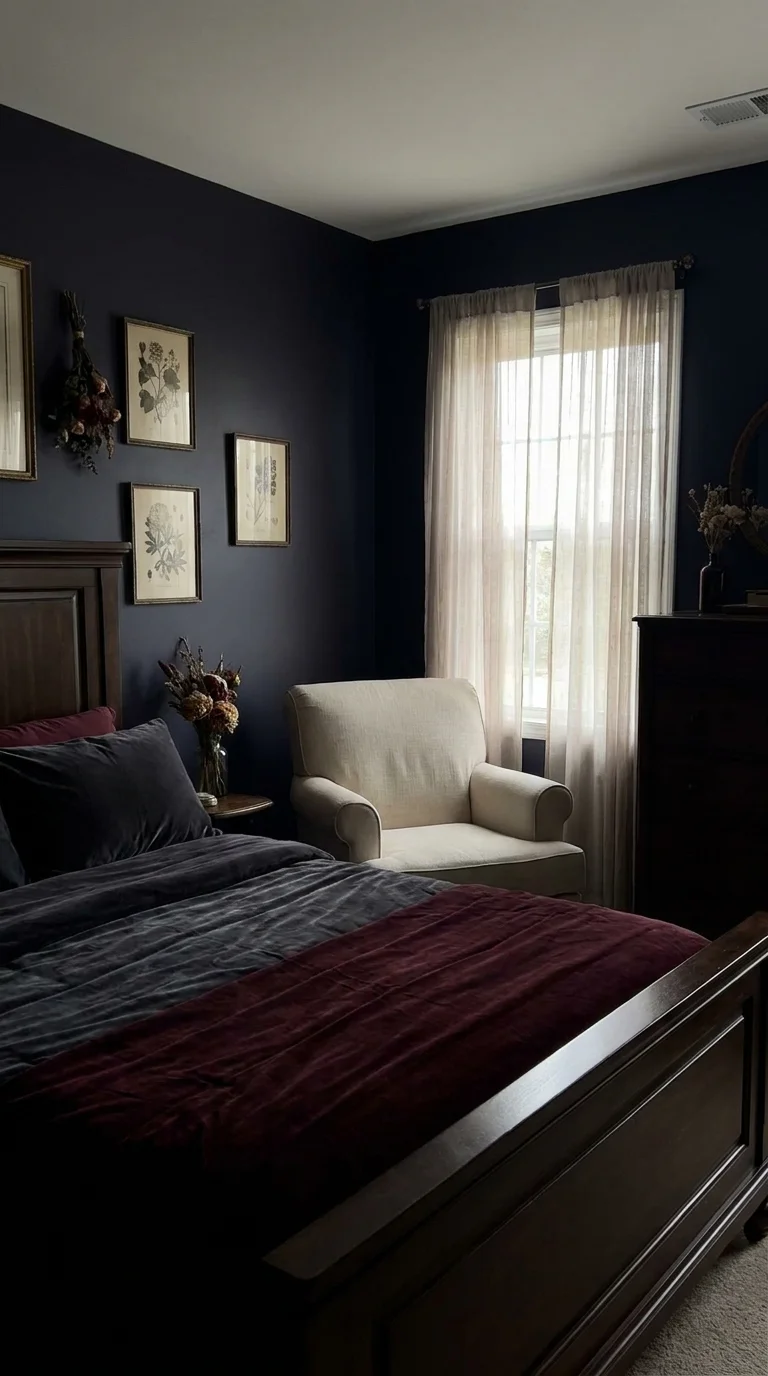
16. Choose Hardware and Fixtures With Ornate, Feminine Detail
Where budget and style allow, hardware with genuine ornate detail, scalloped drawer pulls, a fixture with delicate scrollwork, introduces a level of feminine craft that plain, minimal hardware doesn’t provide. This works particularly well in this specific style, since dark feminine design generally leans toward more traditional, romantic detail than the cleaner lines associated with more minimalist or modern aesthetics.
This doesn’t require ornate detail on every single piece of hardware throughout the room, but incorporating it somewhere, drawer pulls, a mirror frame, a lighting fixture, adds a layer of considered femininity that plain, purely functional hardware misses entirely.

17. Add Fresh or Dried Florals in Deep, Rich Tones
Fresh flowers or a genuinely well-made dried floral arrangement, in deep burgundy, dark red, or rich purple tones, introduce organic softness that echoes the room’s overall color story rather than competing with it. Dried arrangements specifically work well in this style beyond their practical low-maintenance appeal, since their slightly muted, aged coloring often suits a dark, moody palette even better than the brighter tones of fresh-cut flowers.

18. Edit the Final Room With Real Discipline
The instinct to keep layering, more texture, more pattern, more decorative objects, can push a dark feminine bedroom past elegant and into genuinely overwhelming if left unchecked. Stepping back once the major decisions are in place and honestly evaluating whether each additional element is earning its place, rather than simply accumulating because the style technically supports more layering, is what keeps the finished room feeling considered rather than cluttered.
This is worth treating as an ongoing habit rather than a single edit performed once, since a genuinely successful dark feminine bedroom depends on restraint applied consistently, not just at the initial decorating stage but in every small addition made afterward.
A dark feminine bedroom that succeeds holds two qualities in real balance, genuine depth and moodiness on one side, real softness and romance on the other, neither one sacrificed for the sake of the other. Getting that balance right takes more deliberate attention than either extreme alone would require, but the result is a room that feels genuinely elegant rather than simply dark or simply pretty. For a softer take on this warmth, browse our cozy warm bedroom ideas.

19. Hang One Large Mirror to Double the Glow
A dark bedroom swallows light, and a mirror is the cheapest way to get some of it back. One large mirror, hung opposite the window or beside it at a slight angle, bounces daylight across the room during the day and doubles the glow of lamps and candles at night. Small mirrors scattered around the room do not do this job; they read as decoration. One mirror at least 24 inches wide, or a leaning floor mirror about 60 inches tall, is what actually changes the light in the room.
Size and placement follow the same rule as the artwork in idea 14. Hang a wall mirror so its center sits at eye level, about 57 to 60 inches from the floor, and keep it at least two thirds the width of the furniture beneath it. A mirror over a dresser should span roughly two thirds of the dresser width, so a 48 inch dresser takes a mirror about 30 to 32 inches wide. A leaning floor mirror needs a wall with at least 6 inches of clearance on each side and a secure anchor at the top, since a tall mirror in a bedroom gets bumped. The vanity mirror in idea 12 serves the face; this mirror serves the room, and it needs to be bigger to do that job.
Choose a frame in warm gold, rose gold, or aged brass so the mirror ties into the metallics already in the room from idea 3. A black frame works only if the room already has black hardware, otherwise it disappears into the wall and the mirror looks frameless. Avoid a mirror facing the bed directly if it disturbs your sleep; angle it toward a window or a lamp instead, so it reflects light rather than the bed. A framed wall mirror 30 by 40 inches runs about $80 to $150, and a leaning floor mirror about $150 to $250. Check the glass is real mirror glass, not mirrored acrylic, which warps the reflection and scratches easily.
Dark Feminine Bedroom FAQs
Can a dark feminine bedroom work in a small room?
Yes, but the dark color should stay on one wall, the bed, or the bedding, not on all four walls. In a room under about 120 square feet, keep the ceiling and at least one other large surface pale, use a large mirror to bounce the available light, and keep the furniture low and leggy so the floor stays visible. A small dark feminine bedroom fails when every surface is dark and there is no pale element for the eye to rest on.
What is the best wall color for a dark feminine bedroom?
A deep color with a genuinely warm undertone: burgundy, aubergine, deep plum, or a rich chocolate brown. Warm undertones pair naturally with the velvet, silk, and warm metallics this style depends on, while a cool charcoal or navy can push the room toward moody-masculine. Paint a test patch at least 60 by 60 centimeters on the wall opposite the window and check it in morning and evening light before committing, since dark colors shift noticeably through the day.
How much gold or rose gold is too much?
Pick one warm metal finish and repeat it in three or four places: a mirror frame, drawer hardware, a lamp base, and one small decorative object. That repetition reads as deliberate. The line is crossed when two or three different gold tones appear in the same room, or when every surface carries metallic detail, which turns glow into glare. Rose gold leans further into the feminine side than a neutral warm gold, so choose it deliberately based on how strongly feminine the finished room should feel.
Can dark feminine style work with modern furniture?
Yes, as a mix rather than a full commitment either way. Pair one curved statement piece, a scalloped headboard or a rounded nightstand, with clean-lined modern pieces in a dark finish. The curve supplies the feminine half of the balance and the modern lines keep the room from turning into a period reproduction. Avoid pairing dark feminine colors with ornate furniture on every piece; one ornate element is a focal point, five is a theme park.
What color bedding goes with dark burgundy walls?
Deep blush or dusty rose is the safest match, since it shares the wall’s warmth and reads as feminine without competing. Cream or ivory bedding works too, and it doubles as the one light element the room needs. Jewel tones, emerald or sapphire, suit a plum or aubergine wall better than a burgundy one, because burgundy plus emerald can fight. Whatever the color, layer two or three tones within the same family rather than one flat color across the whole bed.
How do I keep a dark feminine bedroom from feeling gloomy?
Three things: one genuinely pale element, warm layered light, and a mirror. The pale element can be cream bedding, an ivory accent chair, or a pale rug. The light should be warm, 2200K to 2700K, from at least three low sources rather than one bright overhead fixture. A large mirror opposite the window doubles whatever daylight the room gets. If the room still feels heavy after those three, the wall color is too dark for the room’s natural light, and repainting one wall pale fixes it faster than adding more decor.


